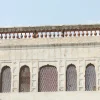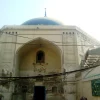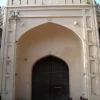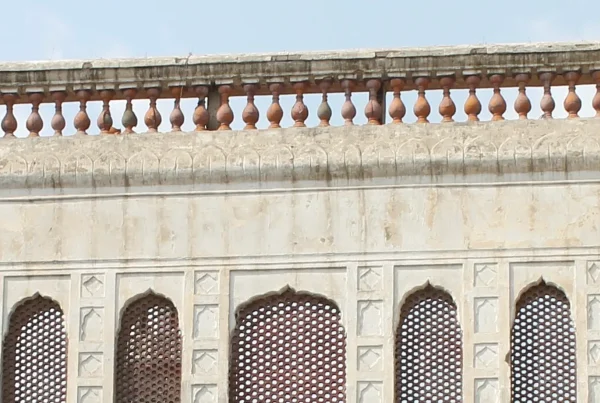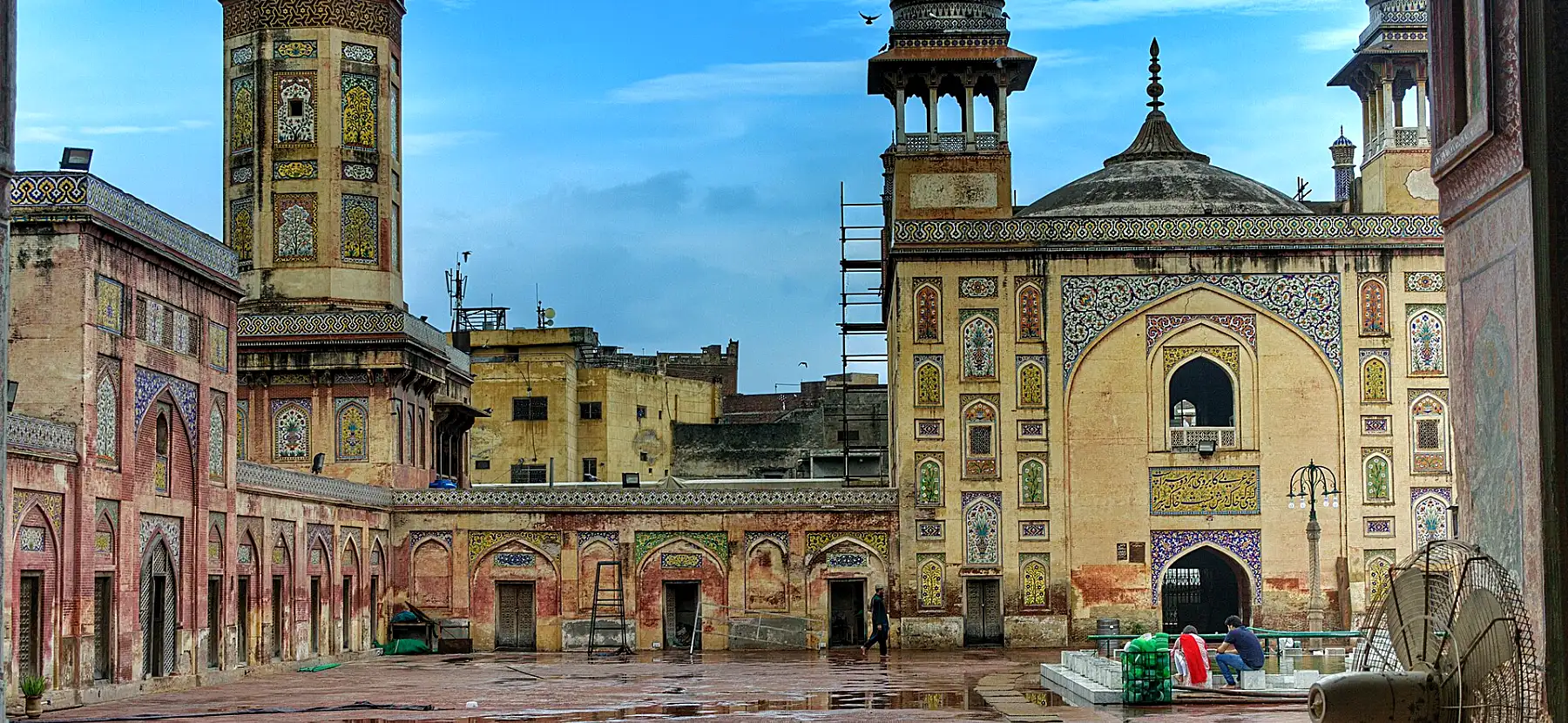
Walk in through Delhi Gate, follow the old Royal Trail for a few minutes, and suddenly the lane opens into a square. In front of you stands Masjid Wazir Khan, its walls covered in blue, yellow and green tiles, with four painted minarets rising above the rooftops. Built between 1634 and 1641, it is often called the most beautifully decorated mosque of the Mughal era.
This guide explains its story, the tiles and frescoes to look for, and how to fit it into a walk through the old city.
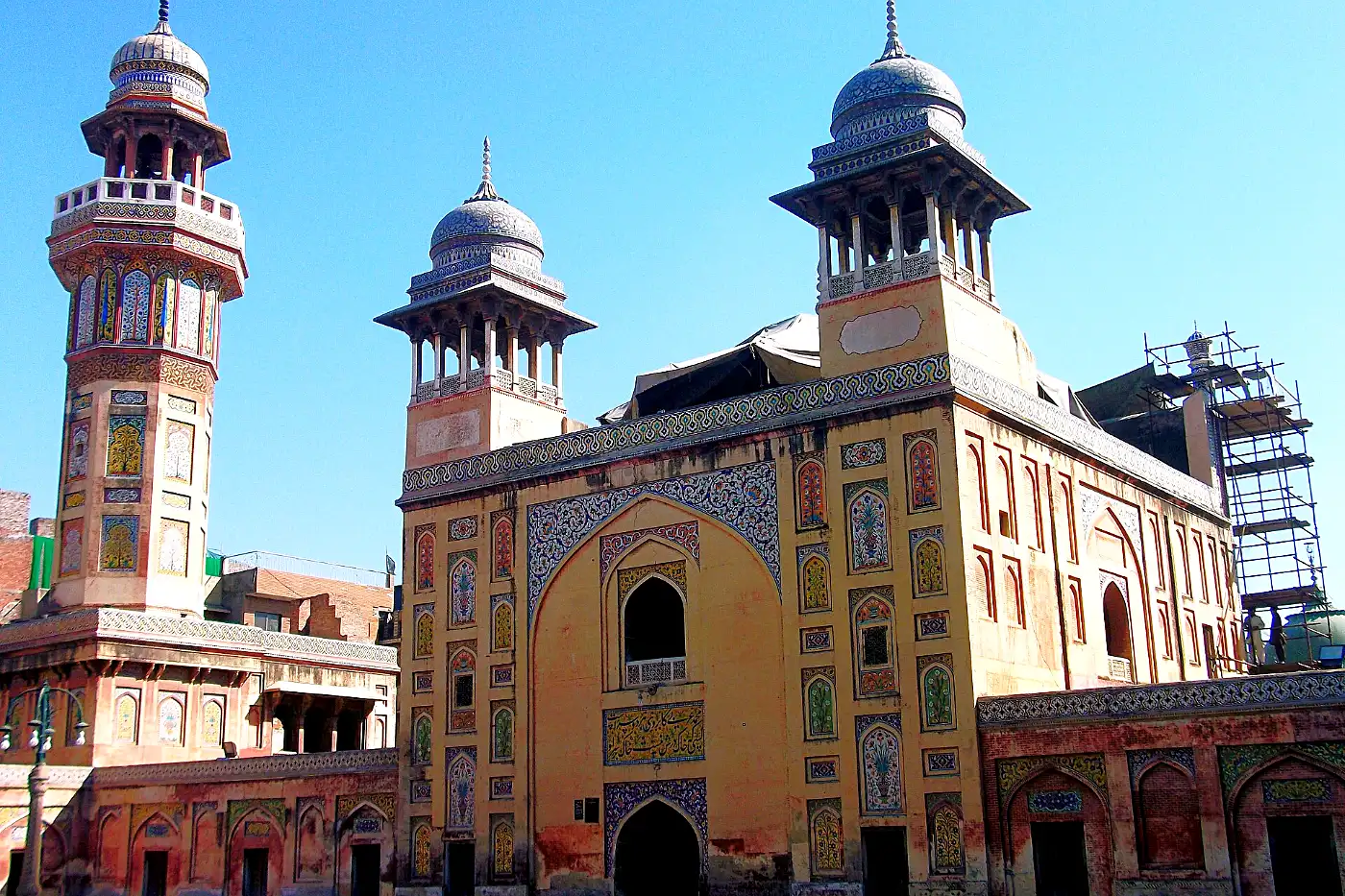
Masjid Wazir Khan and its painted minarets. Photo Credit: Muhammad Umair Mirza, CC BY-SA 4.0.
Quick facts
- Location: Inside Delhi Gate, on the Royal Trail, Walled City of Lahore
- Timings: Open daily, morning to evening; avoid prayer times
- Ticket: Free (donations welcome)
- Time needed: 45 minutes to 1 hour
- Best time: October to March, mornings
- Map: Open in Google Maps
Last checked: November 2026. Full details in Visitor Information.
History of Masjid Wazir Khan
The mosque was built by Hakim Ilmuddin Ansari, a physician from Chiniot who rose to become Shah Jahan’s governor of Lahore and was known by the title Wazir Khan. Work began in 1634, and the mosque was finished around 1641. It was planned as a whole complex: a public square, a gateway lined with shops for calligraphers and bookbinders, and the mosque itself.
Inside the courtyard lies the tomb of Syed Muhammad Ishaq, a Sufi saint popularly known as Miran Badshah, who was buried here long before the mosque was built.
Saved and Restored
Unlike the Badshahi Masjid, Masjid Wazir Khan was not turned into a stable or a store under Sikh rule, which helped it survive in good shape. Since 2009, the Walled City of Lahore Authority and the Aga Khan Cultural Service-Pakistan have documented and restored it step by step. The square in front, Chowk Wazir Khan, was cleared of encroachments and reopened in 2017, and in 2026 work continued on the domes, walls and roofs.
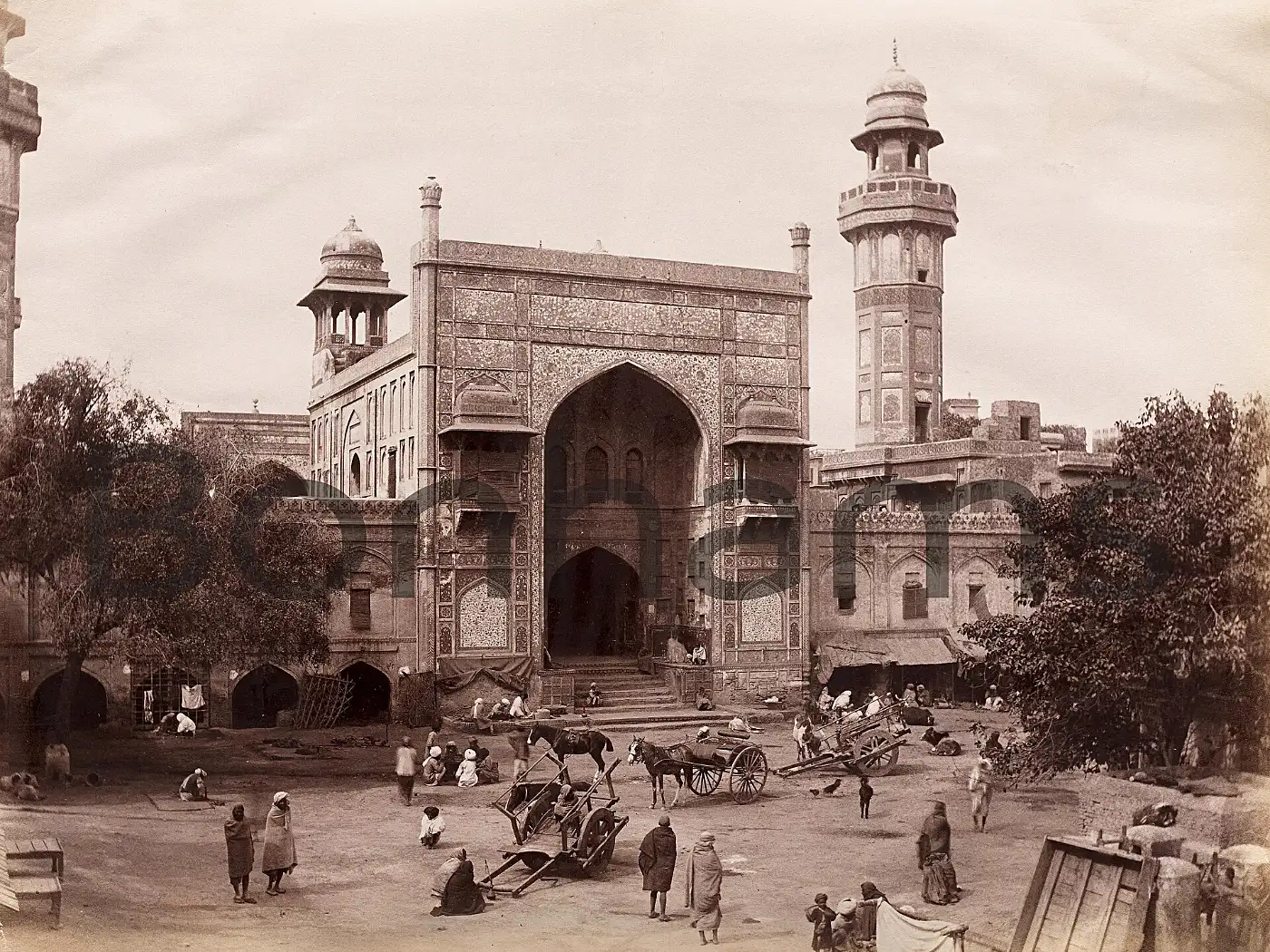
The mosque and its square in the 19th century. Photo Credit: Unknown photographer.
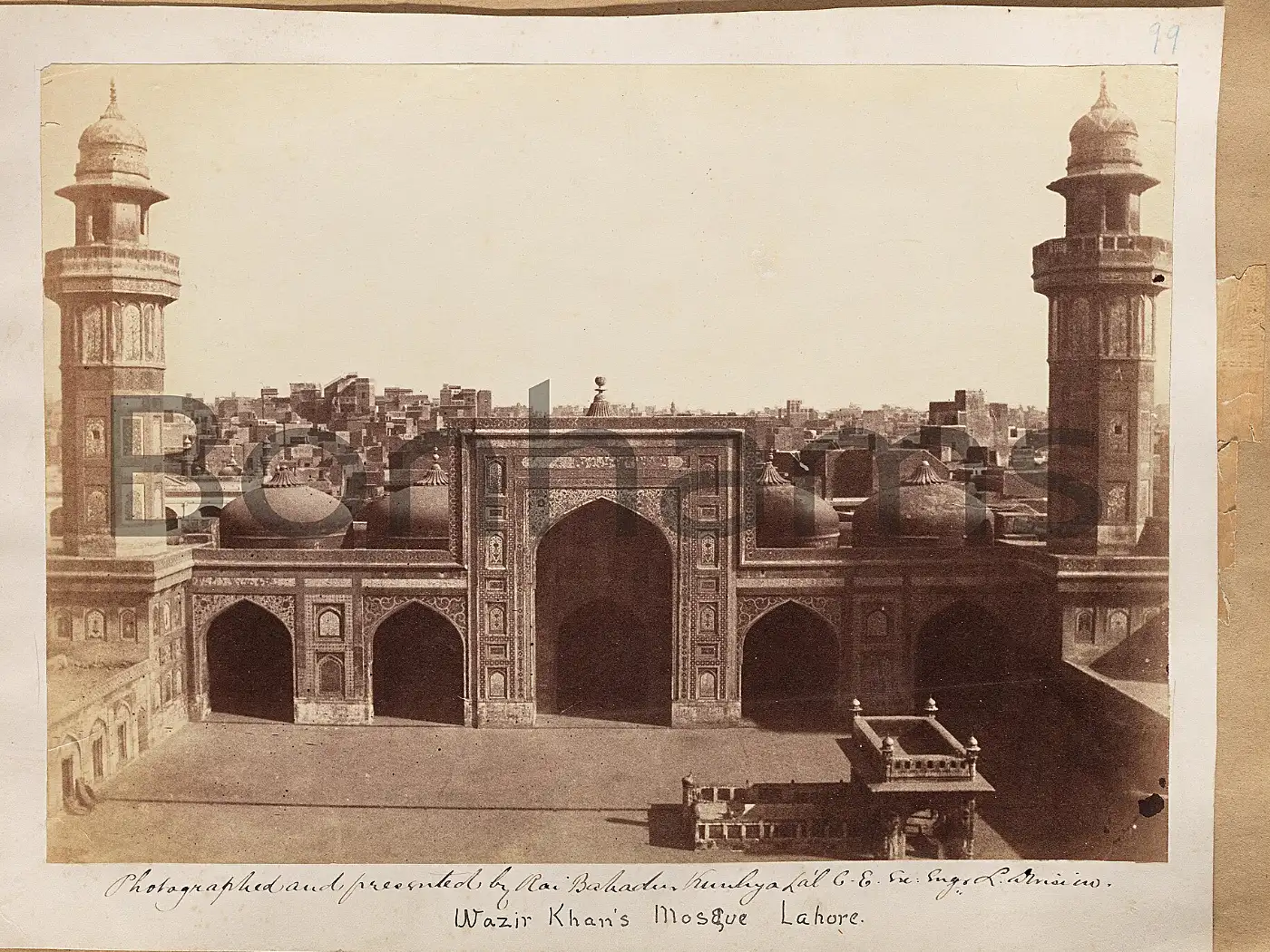
An early photograph of the mosque. Photo Credit: Unknown photographer.
What to See
The Gateway and Calligraphers’ Bazaar
The tall entrance on the eastern side is covered in tile panels and Persian inscriptions. Behind it, a covered passage of small shops, the old Calligraphers’ Bazaar, leads into the mosque. Look up at the octagonal space in the middle, where light falls from a small dome.
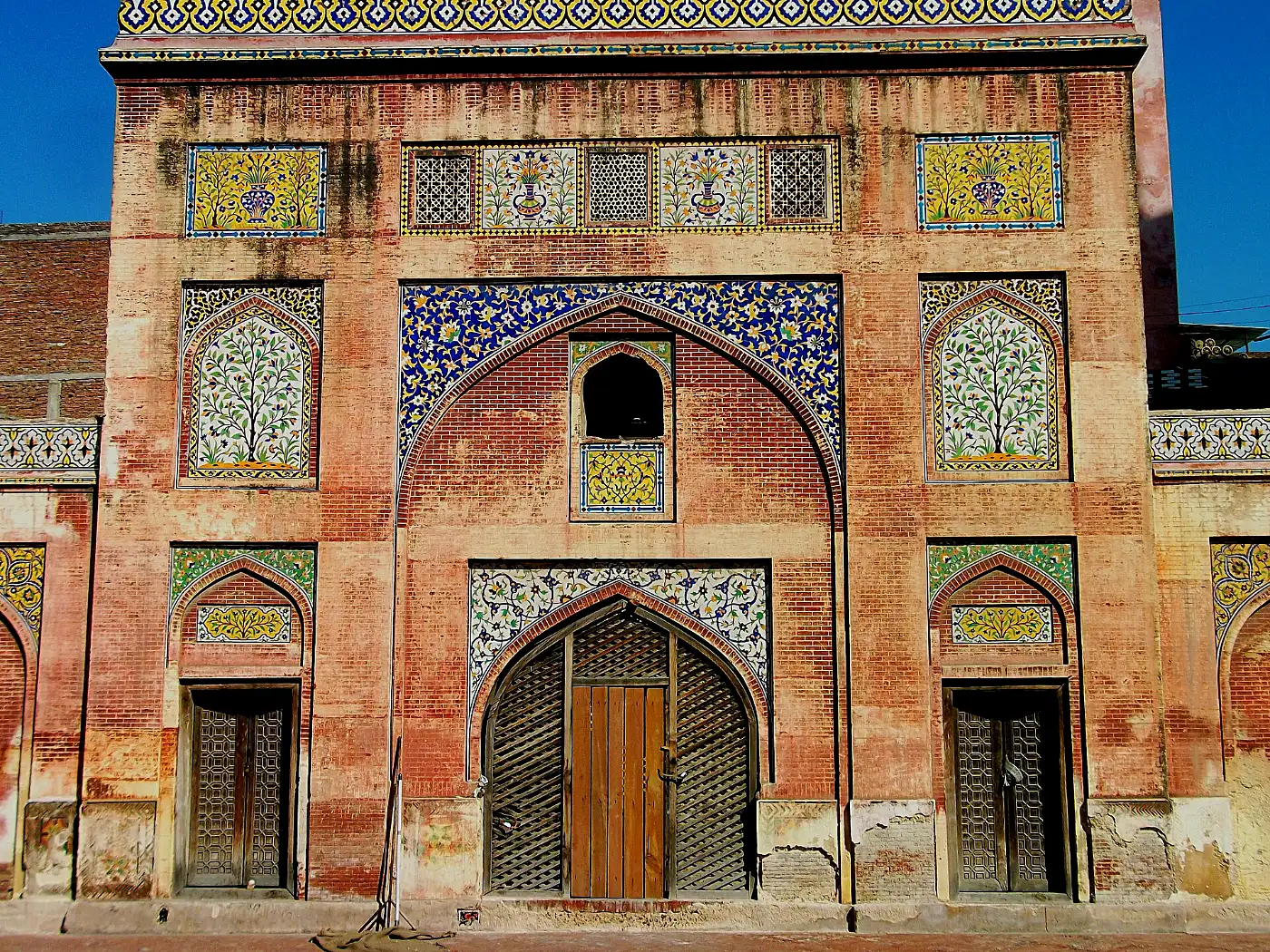
Tile panels on the gateway. Photo Credit: Muhammad Umair Mirza, CC BY-SA 4.0.
The Courtyard
The brick-paved courtyard has a pool for ablution in the middle and rows of small rooms, once used by students, along the sides. From here you can see all four octagonal minarets, each topped with a little pavilion.
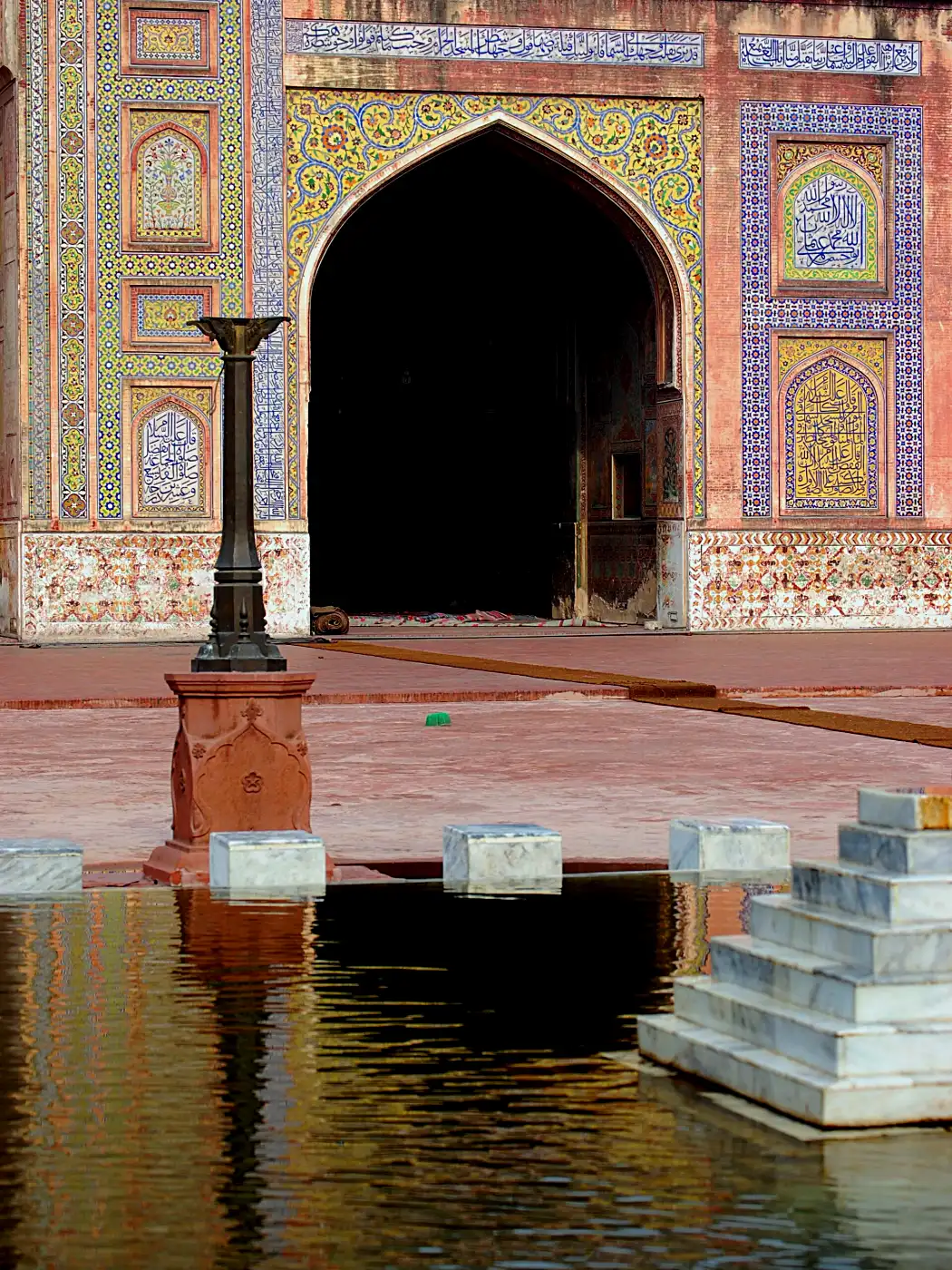
The ablution pool and the prayer hall. Photo Credit: Maham Bhatty, CC BY-SA 3.0.
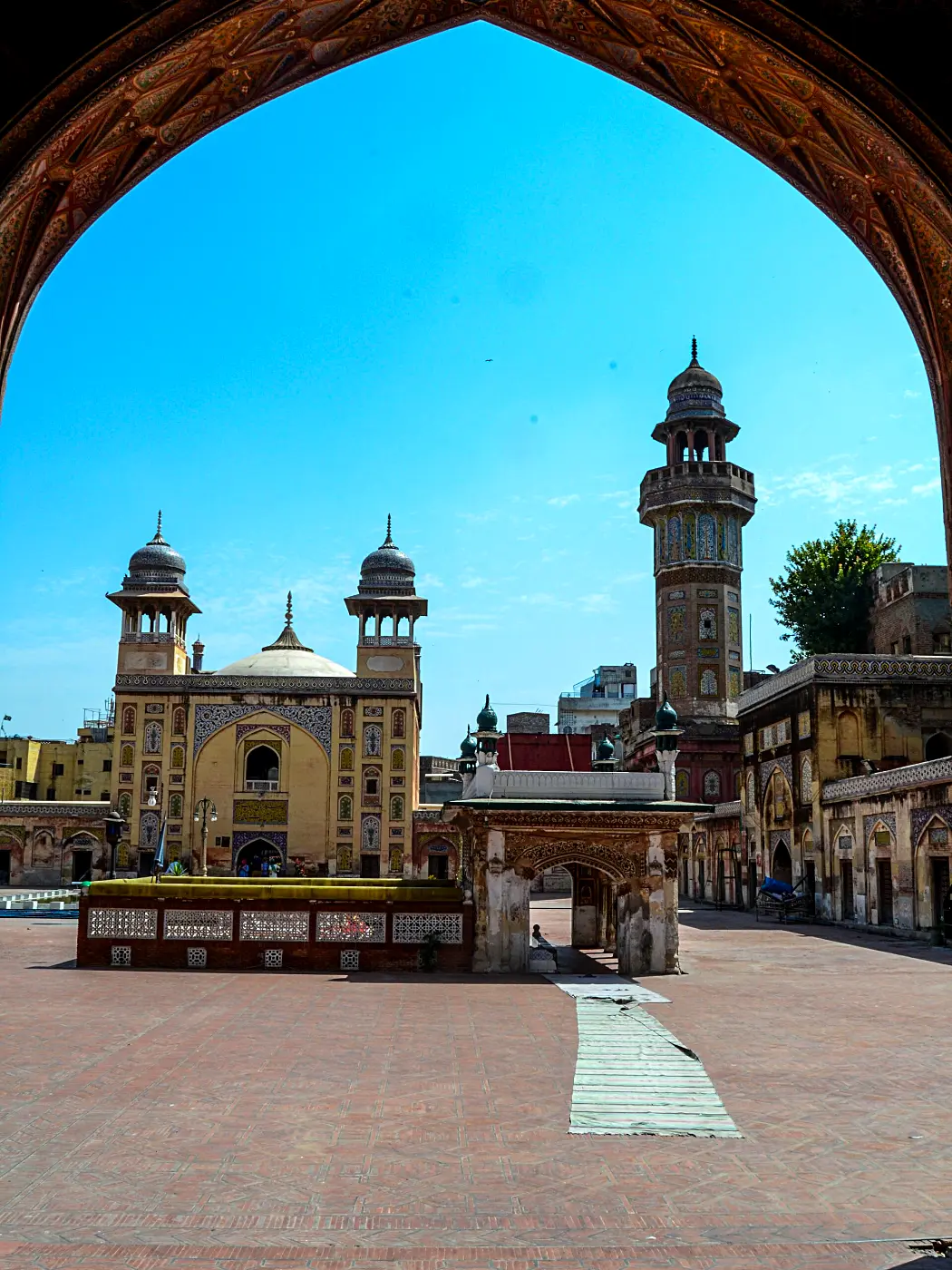
The courtyard through an arch. Photo Credit: Sinan Farooqui, CC BY-SA 4.0.
Kashi Kari Tile Work
Masjid Wazir Khan is famous for kashi kari, a Persian-style tile mosaic. Small pieces of glazed tile in cobalt blue, turquoise, yellow, orange and green are fitted together into flowers, vases, cypress trees and Quranic calligraphy. The colours are still bright after almost four centuries.
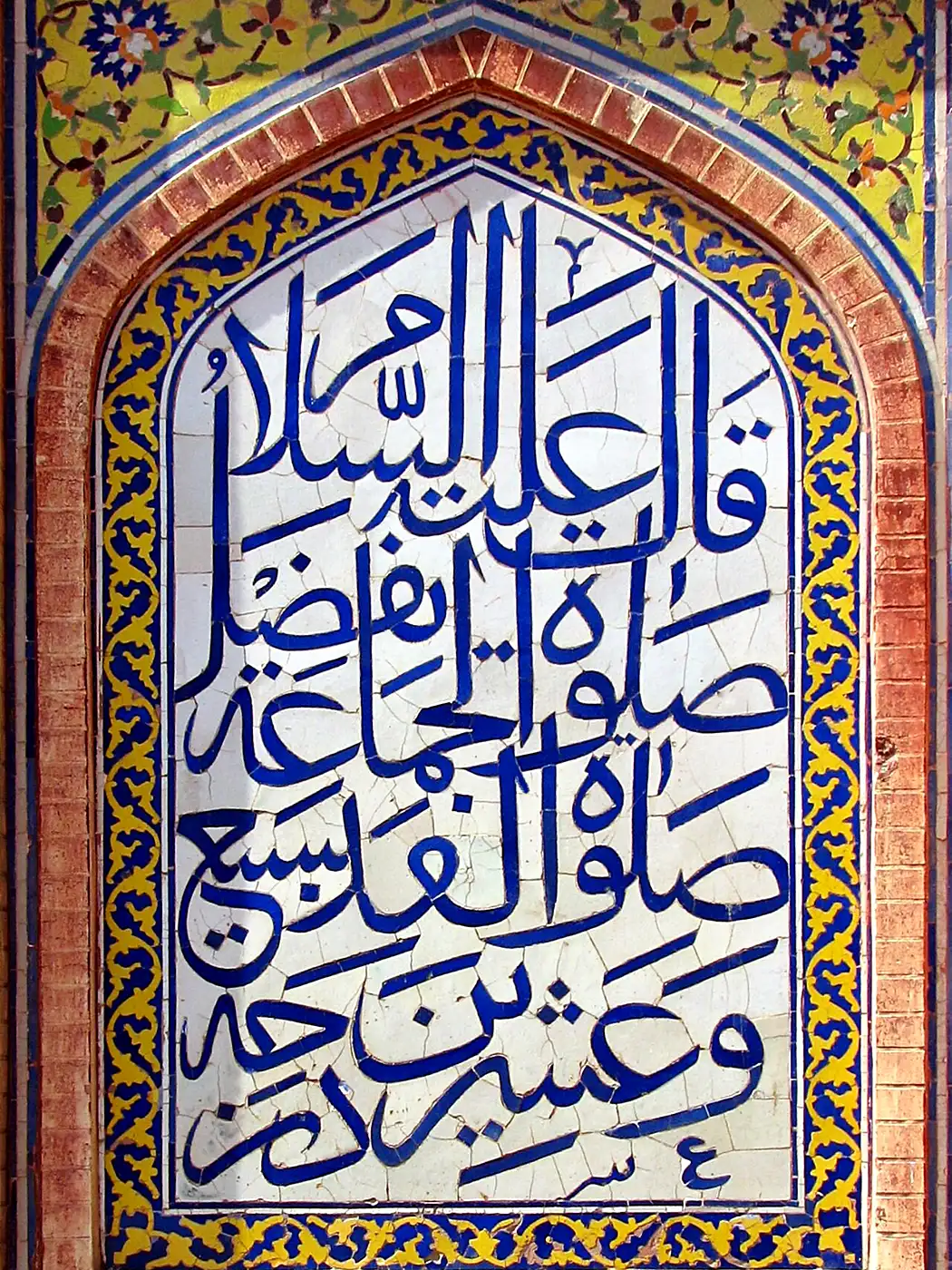
A calligraphy panel in tile mosaic. Photo Credit: Diaa Abdelmoneim, CC BY-SA 3.0.
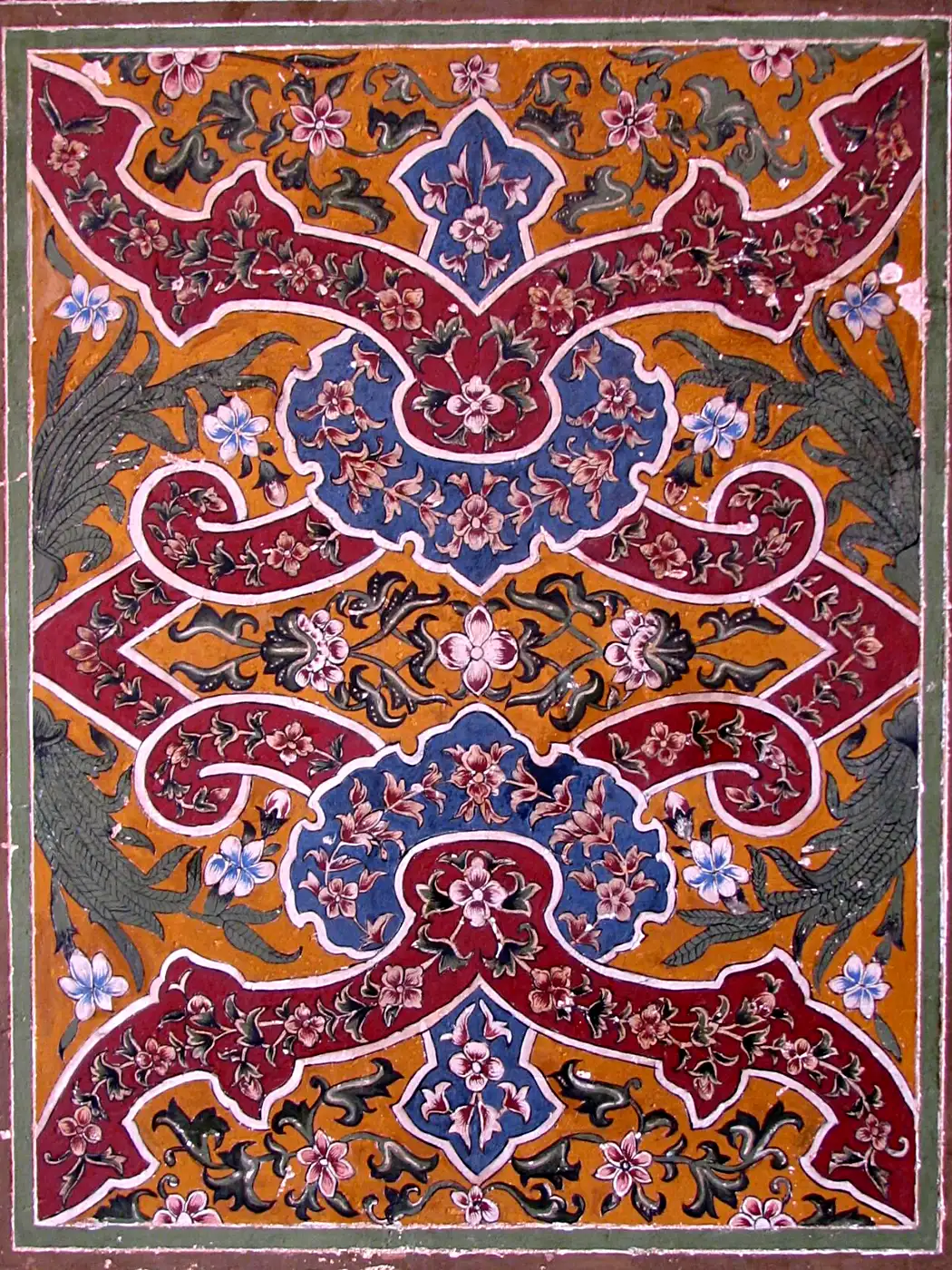
Floral tile work. Photo Credit: Atif Gulzar, CC BY-SA 3.0.
Frescoes of Masjid Wazir Khan
Inside the prayer hall, almost every surface is painted. Look for floral frescoes, honeycomb muqarnas in the corners, and calligraphy around the arches. Stand under each of the five domes and look up, as every ceiling has a different pattern.
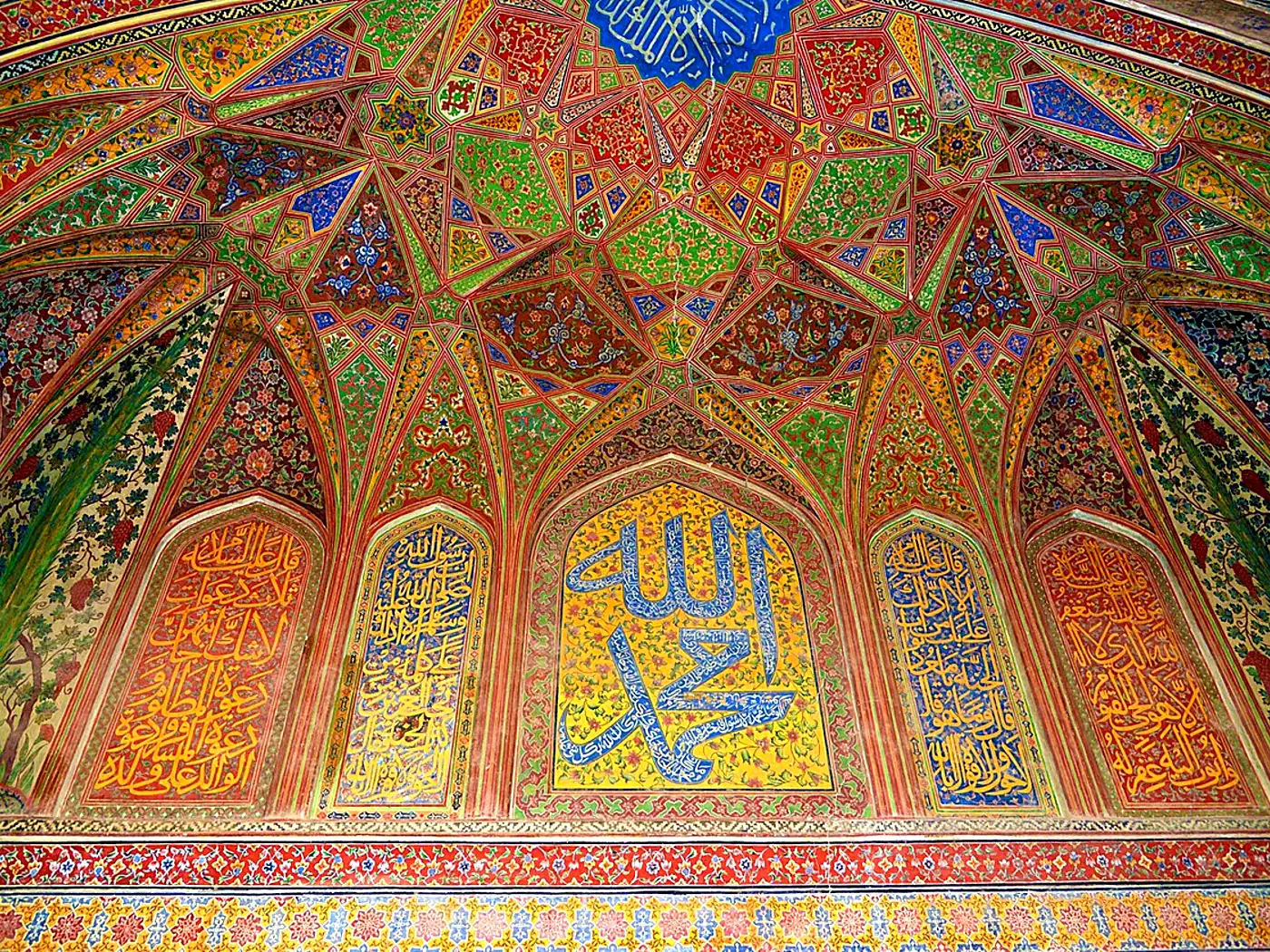
Frescoes in the prayer hall. Photo Credit: Aizad Sayid, CC BY-SA 4.0.
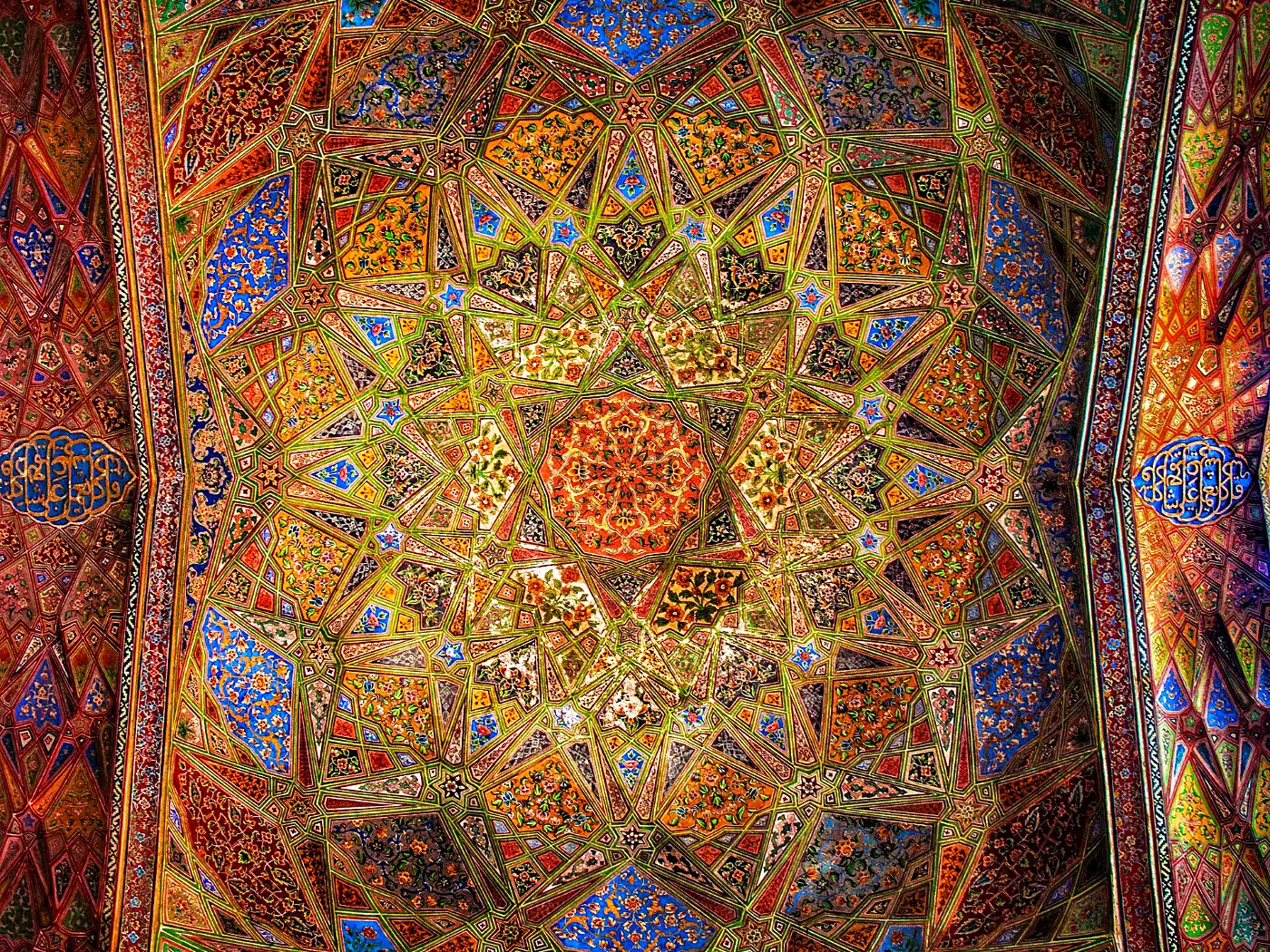
A painted dome ceiling. Photo Credit: Abdulmutlib12, CC BY-SA 3.0.
The Minarets
Four minarets stand at the corners of the courtyard. Their tiled shafts and little domed pavilions are a favourite subject for photographers.
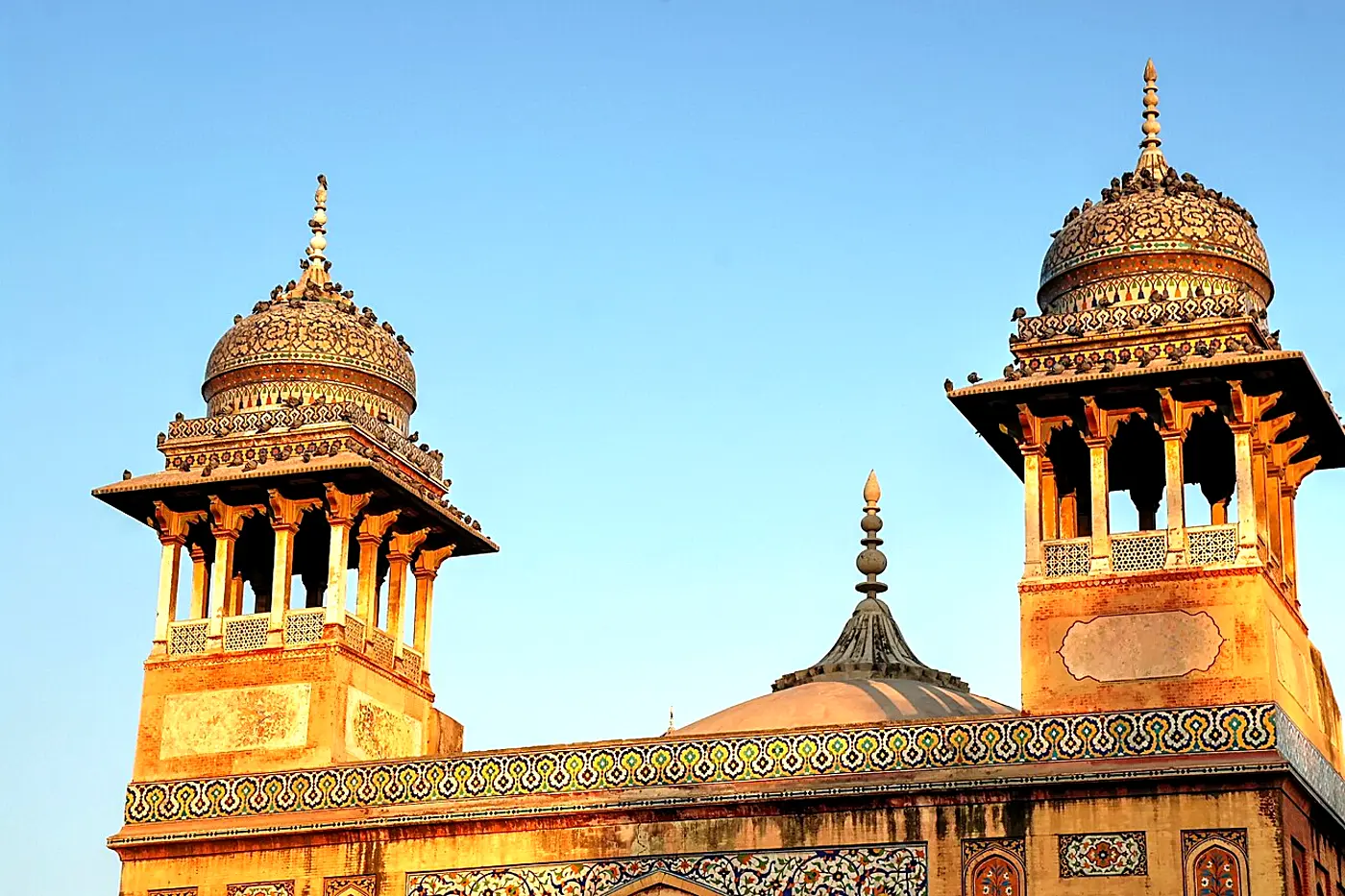
The minaret pavilions. Photo Credit: Kamran Aslam, CC BY-SA 4.0.
Things to Do
- Walk the Royal Trail: Start at Delhi Gate, see the Shahi Hammam, then reach the mosque, and carry on to the Sunehri Masjid.
- Best photo spot: Chowk Wazir Khan in front of the gateway, and the courtyard corners for all four minarets.
- Look closely: Bring a phone with good zoom for the tile calligraphy high on the walls.
- Tea stop: Rest at Usman Ki Baithak in a lane near Delhi Gate.
- Heritage tours: The Walled City of Lahore Authority runs guided walks of the Royal Trail that include the mosque.
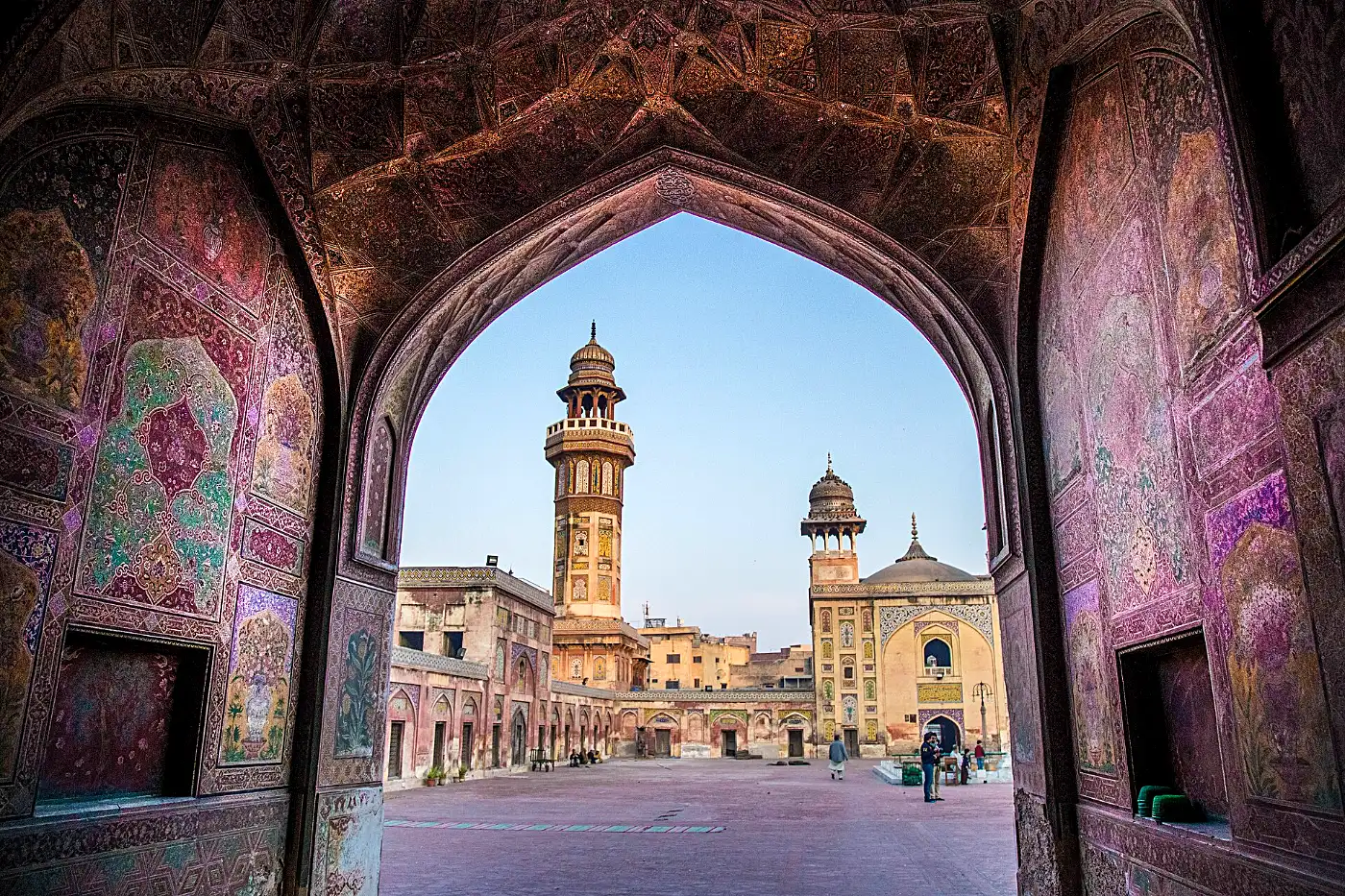
The mosque seen through an old arch. Photo Credit: Umair Khan, CC BY 2.0.
Food Nearby
The Walled City is full of food. Near the mosque, small shops sell lassi, chai and sweets, and you can try halwa puri or nihari for breakfast. For a sit-down meal, walk to Fort Road Food Street or the restaurants near Delhi Gate. Simple meals cost around PKR 300 to 1,000 per person.
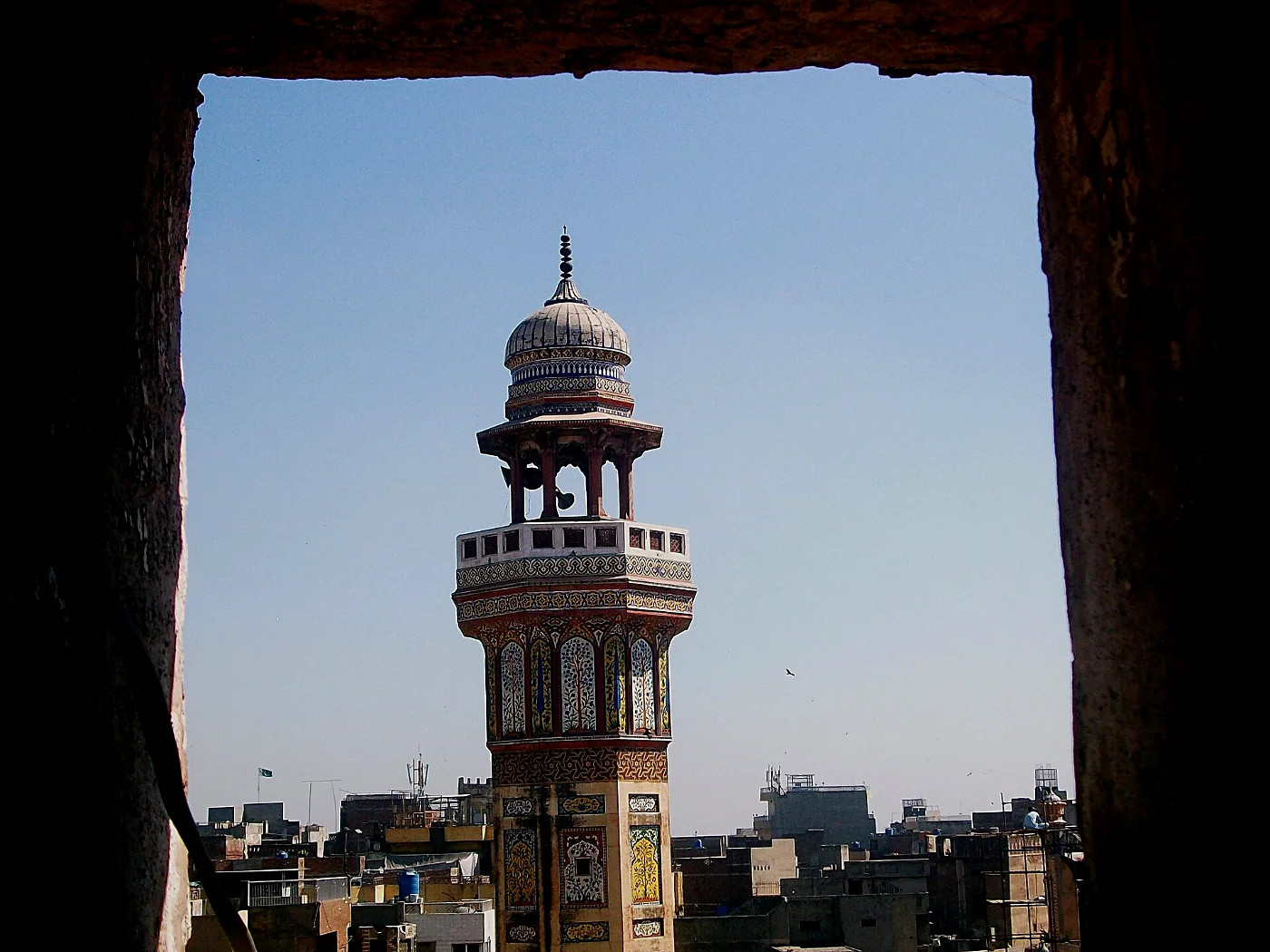
A minaret framed by a window. Photo Credit: Muhammad Umair Mirza, CC BY-SA 4.0.
Visitor Information
Visiting Masjid Wazir Khan
- Location: Shahi Guzargah, inside Delhi Gate, Walled City of Lahore.
- Timings: Open daily from morning to evening. Visit between prayers, and avoid Friday Jummah.
- Entry fee: Free; donations are welcome.
- Dress code: Cover arms and legs; women should cover their heads. Shoes come off at the entrance.
- Best time: October to March, in the morning when the light falls on the tiles.
- Time needed: 45 minutes to an hour, or half a day with the Royal Trail.
- Restoration: Conservation work was still going on in 2026, so parts may be screened off.
- Photography: Allowed; do not photograph people while they pray.
- Accessibility: The lanes are narrow and crowded, and there are steps at the entrance.
Last checked: November 2026. Timings and prices can change, especially in Ramadan and on public holidays.
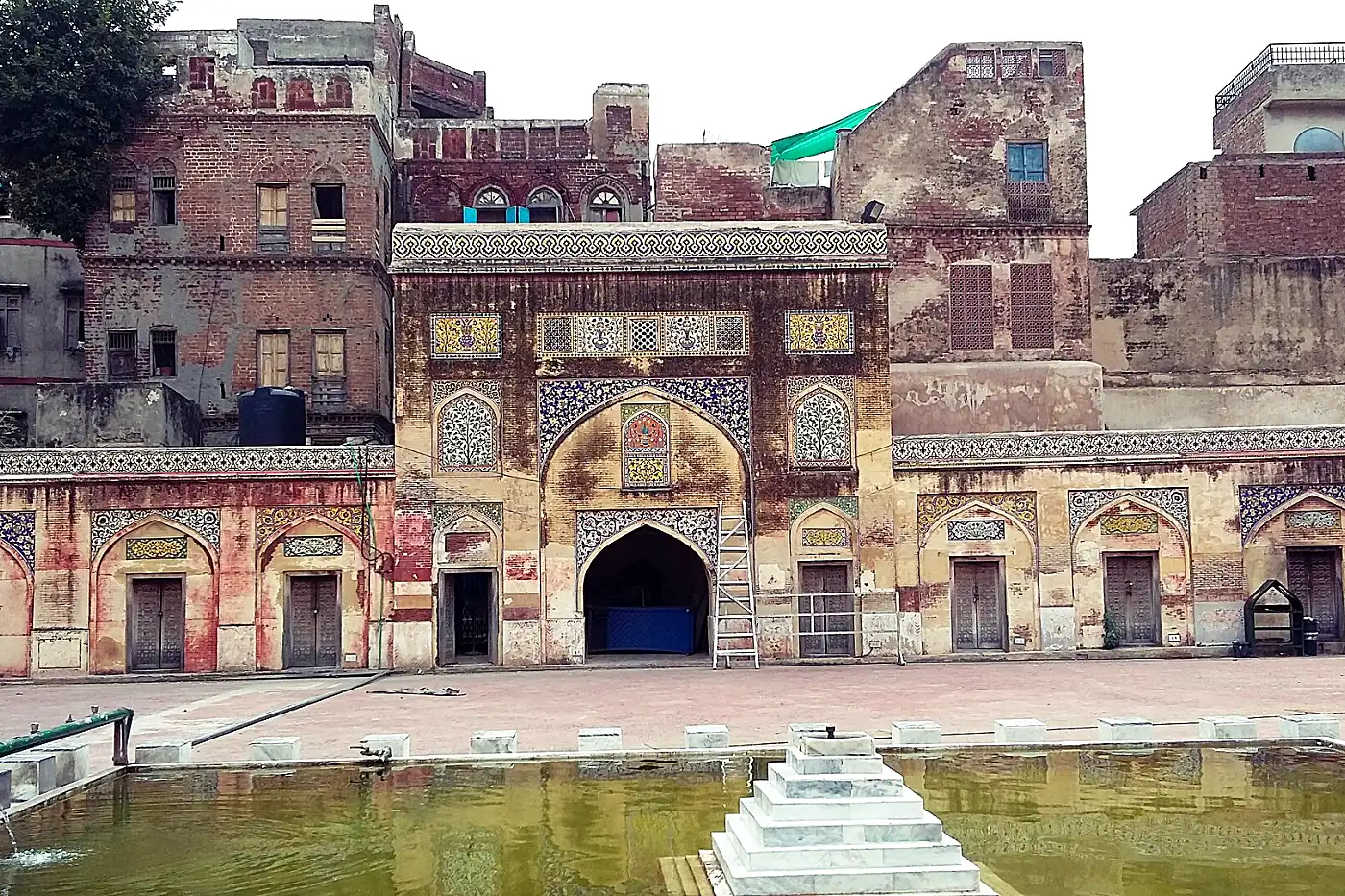
The courtyard and its rows of rooms. Photo Credit: Sahar Sohail, CC BY-SA 4.0.
How to Get There
The mosque is inside the Walled City, about 300 metres west of Delhi Gate along the Shahi Guzargah (Royal Trail). Take a rickshaw, Careem or inDrive to Delhi Gate on Circular Road, then walk through the bazaar. The nearest Orange Line station is at the Railway Station area; from there a short rickshaw ride brings you to Delhi Gate. Cars cannot reach the mosque, so park on Circular Road.
Places to Visit Nearby
- Delhi Gate: the eastern gate where the Royal Trail begins.
- Shahi Hammam: the Mughal bath house built by the same Wazir Khan.
- Sunehri Masjid: the golden-domed mosque further along the trail.
- Usman Ki Baithak: a cosy chai corner near Delhi Gate.
- Lahore Fort: at the end of the Royal Trail.
Planning more days in the city? See our things to do in Lahore guide.
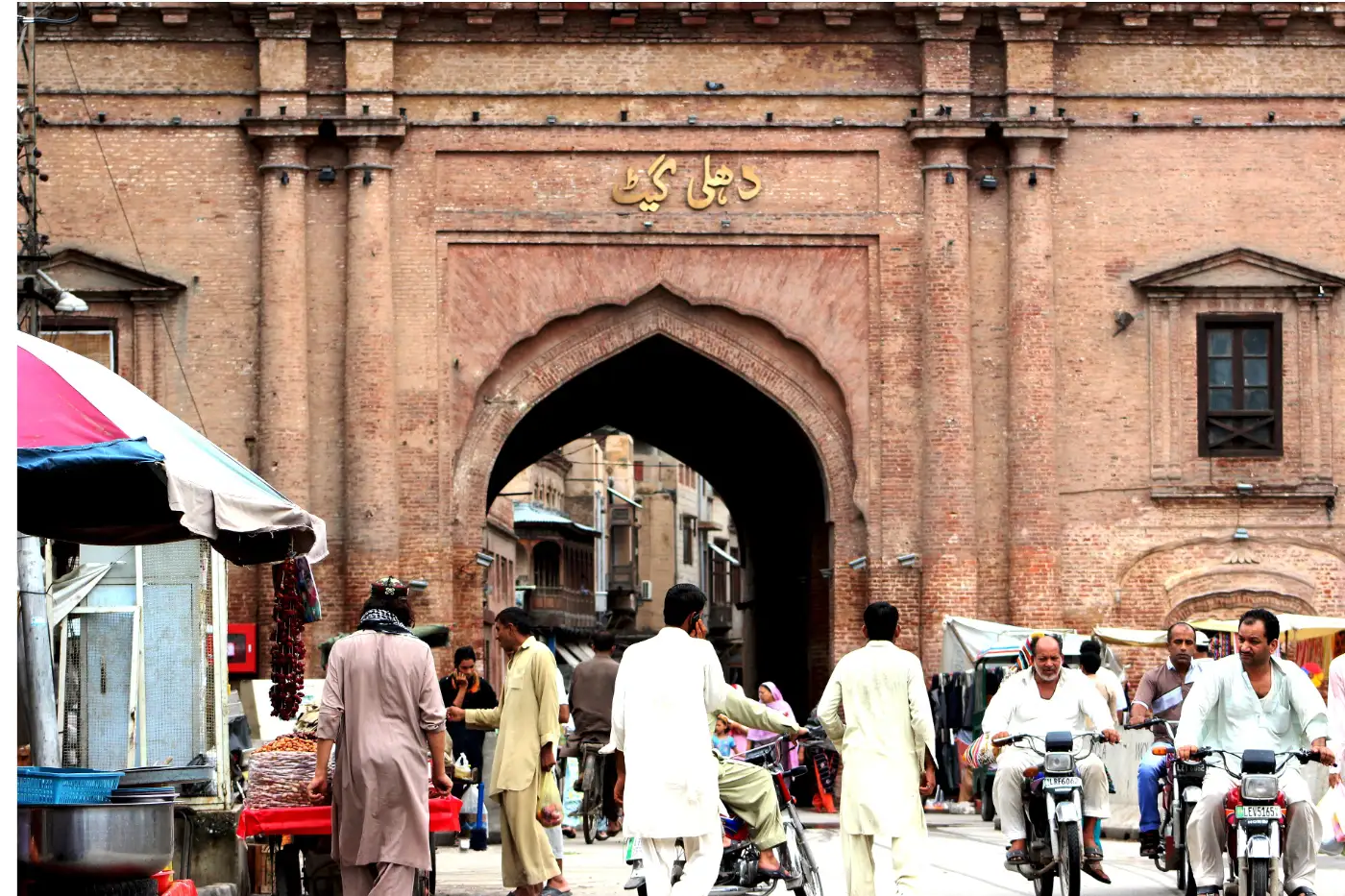
The busy entrance of Delhi Gate. Photo Credit: Asaad Ghafoor, CC BY-SA 4.0.
Frequently Asked Questions
Who built Masjid Wazir Khan?
Hakim Ilmuddin Ansari, known as Wazir Khan, the governor of Lahore under Shah Jahan, built it between 1634 and 1641.
Is there an entry fee for Masjid Wazir Khan?
No, entry is free, though donations are welcome.
How far is Masjid Wazir Khan from Delhi Gate?
About 300 metres, a five-minute walk along the Royal Trail.
Can women and non-Muslims visit?
Yes, everyone is welcome outside prayer times, as long as they dress modestly.
Conclusion
Masjid Wazir Khan is one of those places that makes you slow down. Its tiles, frescoes and quiet courtyard sit in the middle of one of Lahore’s busiest bazaars, and the contrast is part of the magic. Walk the Royal Trail from Delhi Gate, spend an hour here, and then carry on to the Sunehri Masjid and the Lahore Fort.
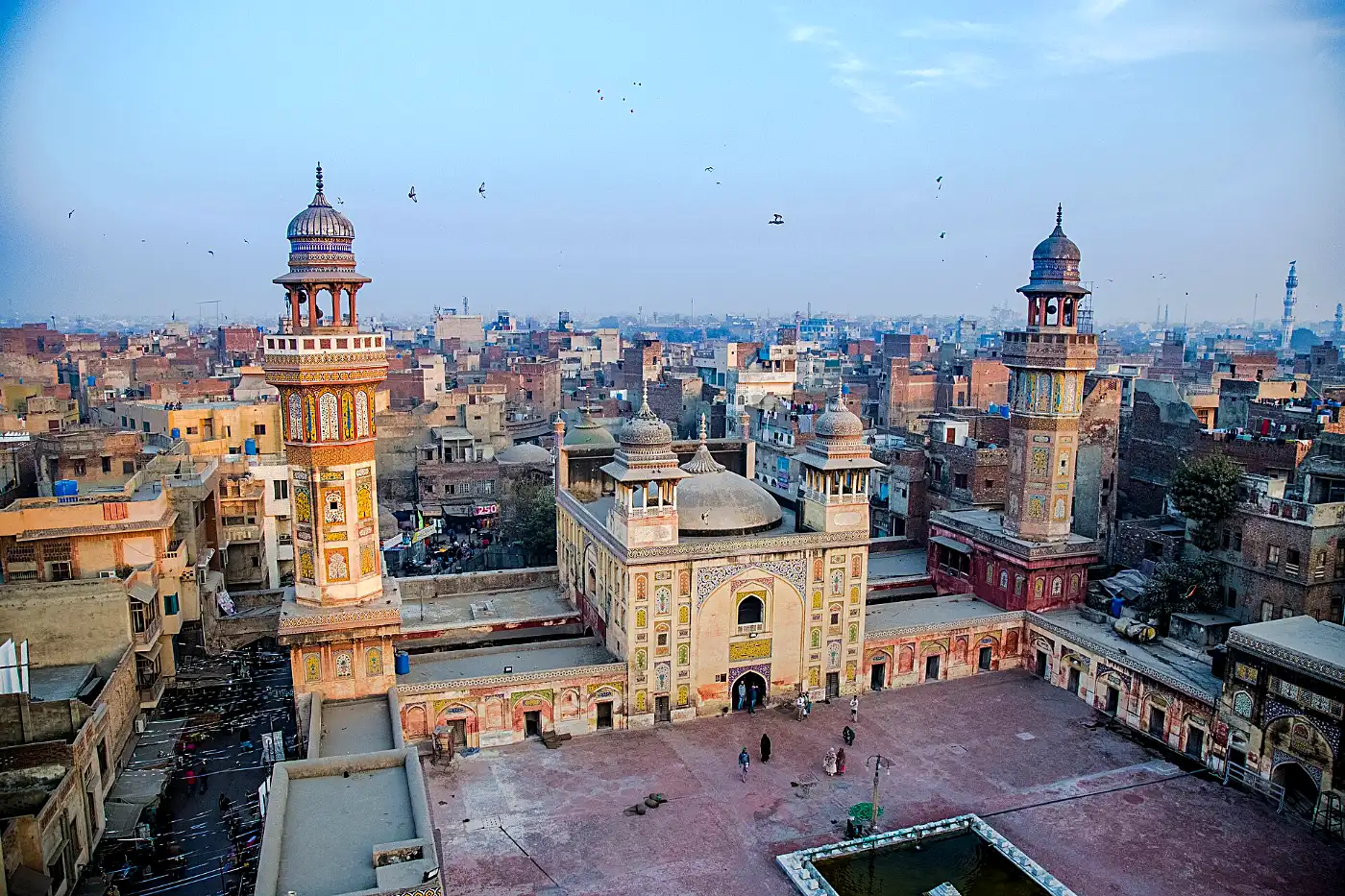
The mosque rising above the old city. Photo Credit: Umair Khan, CC BY 2.0.
Cover photo: Fariah Mubin 93, CC BY-SA 4.0.