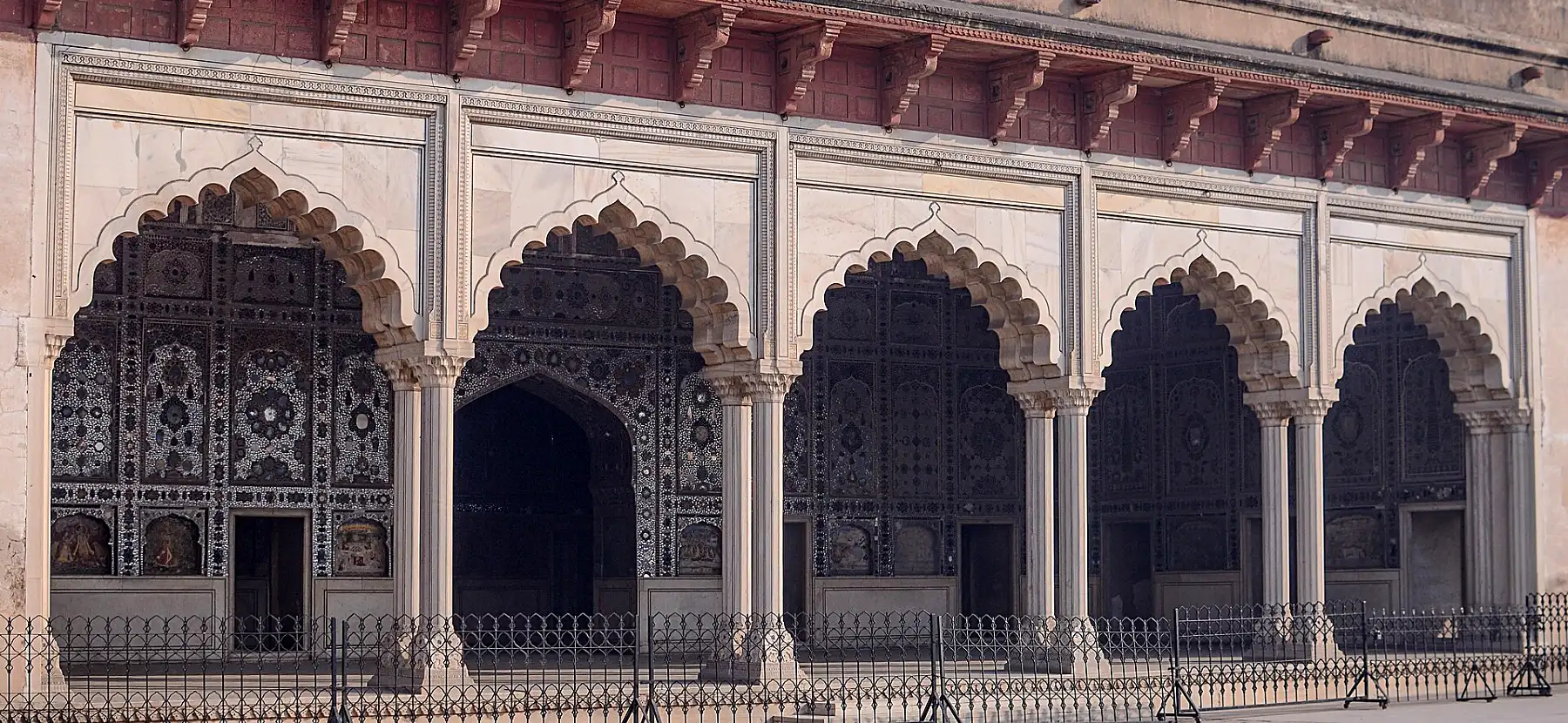
Deep inside the Lahore Fort, in its quiet north-western corner, there is a hall that sparkles like a night sky. In fact, its walls and ceilings are covered with thousands of tiny pieces of mirror set in white plaster and marble. So, when light falls on them, the whole room glitters. This is the Sheesh Mahal Lahore, the famous Palace of Mirrors that Shah Jahan built in 1631-32.
For most visitors, therefore, it is the highlight of a trip to Shahi Qila. In this guide, we share its story, what to look for inside, and how to plan your visit.
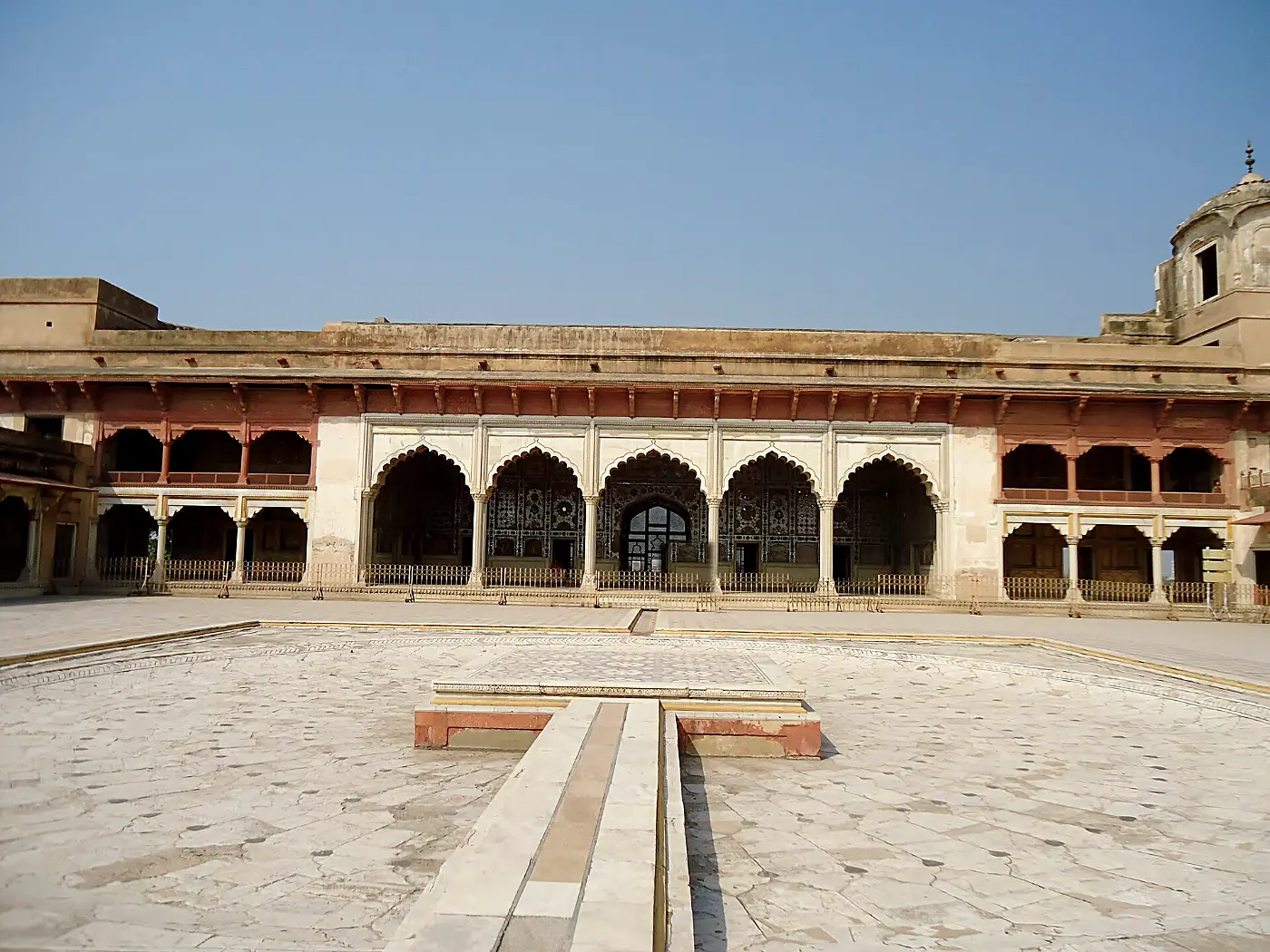
The Sheesh Mahal courtyard inside the Shah Burj block. Photo Credit: Nahid Asad, CC BY-SA 3.0.
Quick facts
- Location: Shah Burj, north-west corner of Lahore Fort
- Timings: About 8:30 am to 5:30 pm; night tours too
- Ticket: Lahore Fort ticket, often plus a Sheesh Mahal ticket
- Time needed: 30 to 45 minutes
- Best time: November to March, early morning
- Map: Open in Google Maps
Last checked: November 2026. Full details in Visitor Information.
History of Sheesh Mahal
The Sheesh Mahal stands in the Shah Burj, a block of private palaces that Emperor Jahangir began. Later, Shah Jahan rebuilt and decorated these royal quarters between 1628 and 1634, and the mirror hall itself dates from 1631-32. Back then, only the princes, the vizier and a few trusted nobles could enter this part of the fort. In fact, the emperor held his private council meetings in this very hall.
Meanwhile, a popular story says Shah Jahan built it as a gift for his beloved wife, Mumtaz Mahal. Sadly, she died in 1631, so she never saw the finished palace.
Sikh and British Times
Later, the Sheesh Mahal became a favourite place of Maharaja Ranjit Singh. He added rooms on top of it, and his artists painted new frescoes in the Kangra style. He also closed the old entrance to the courtyard and built the Athdara pavilion in its place. Moreover, he liked to show off the Koh-i-Noor diamond here.
Then, on 29 March 1849, the British formally took over the Punjab in a ceremony at the Sheesh Mahal. After that, the building slowly decayed. For example, plaster fell from the veranda ceiling in 1904-05, so the British listed the building and repaired it in 1927.
Protection and Restoration
In 1975, Pakistan declared the Sheesh Mahal a protected monument. Then, in 1981, it joined the UNESCO World Heritage Site of Lahore Fort and Shalamar Gardens. Today, the Walled City of Lahore Authority and the Aga Khan Cultural Service-Pakistan are conserving the Shah Burj block. As of 2026, careful work on the mirror hall is still going on, so some parts may be screened off.
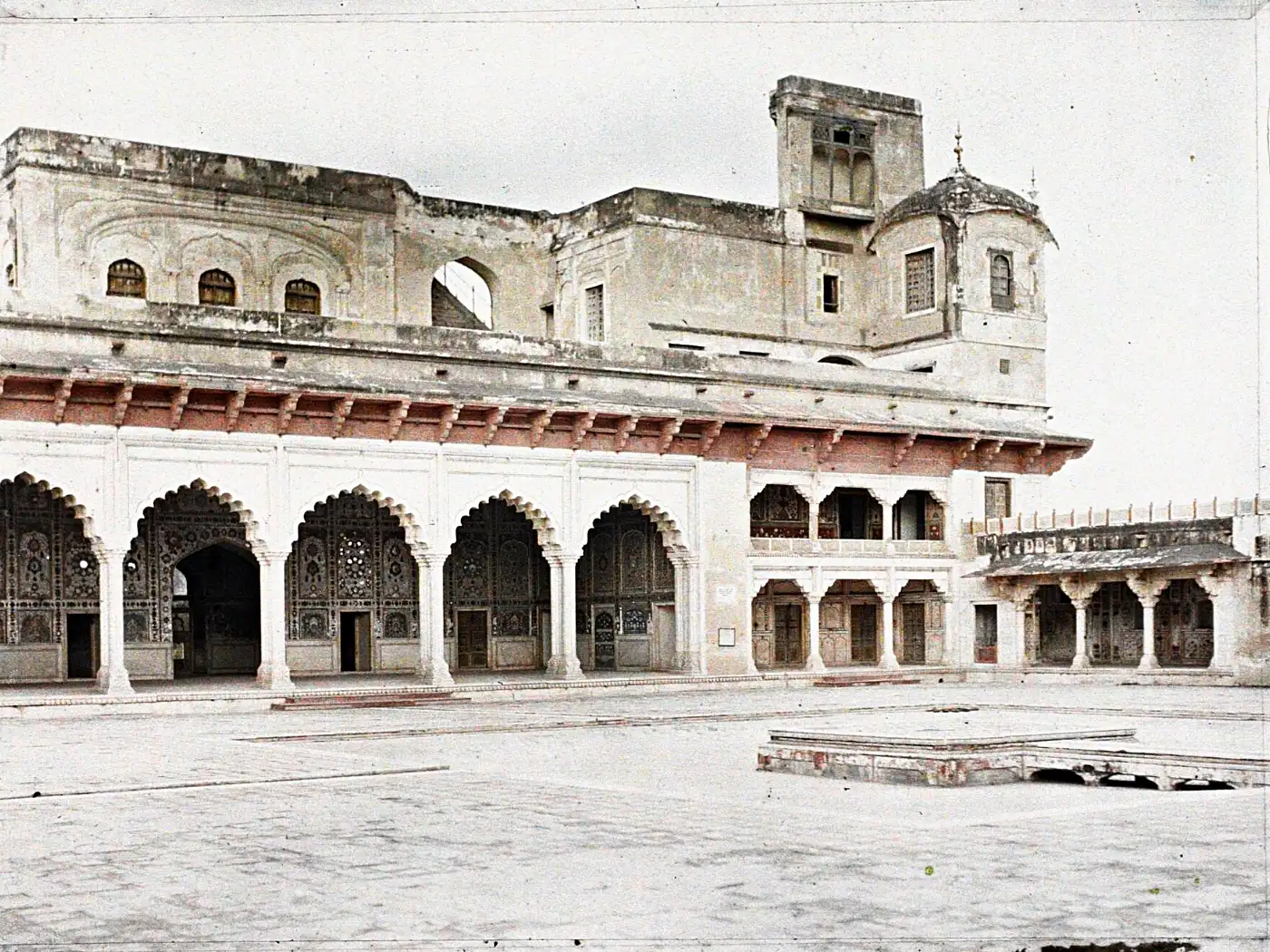
The Sheesh Mahal in an early colour photograph from 1914. Photo Credit: Stéphane Passet.
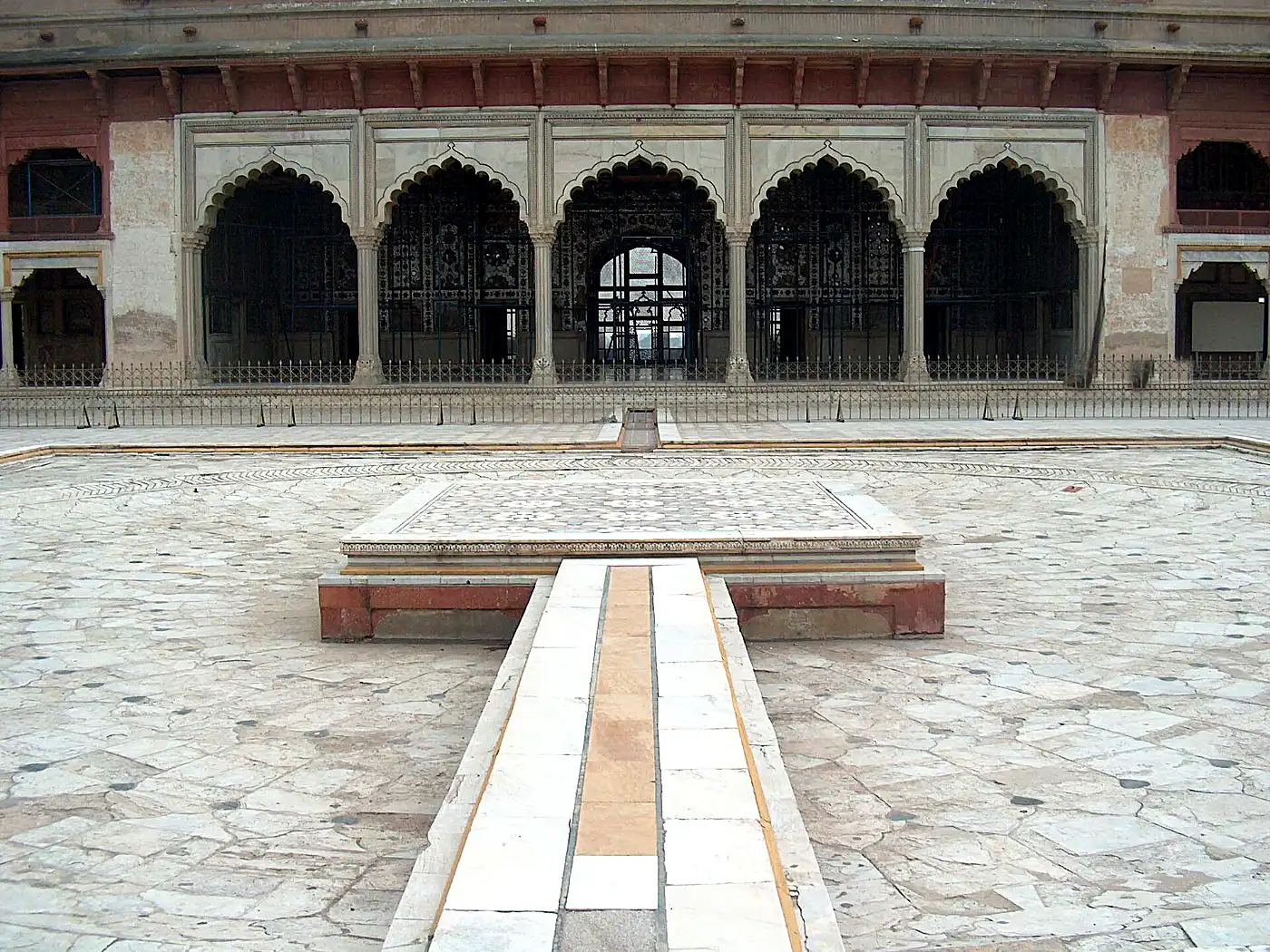
The five marble arches seen across the courtyard. Photo Credit: Ali Imran, CC BY-SA 3.0.
Architecture and Design
What Makes Sheesh Mahal Lahore Special
First, look at the front. Five cusped marble arches rest on slim paired columns and open onto a wide courtyard. Behind them, moreover, the palace is semi-octagonal in plan, so the walls fold around you as you walk in. Also, the central hall rises two storeys high.
In particular, Mughal craftsmen used three main skills here. For instance, ayina kari is the art of setting small mirrors and convex glass into plaster. Similarly, munabat kari is fine stucco tracery. Finally, pietra dura is marble inlaid with coloured and semi-precious stones. In the past, servants lit candles at night, and the flames danced across thousands of mirror pieces.
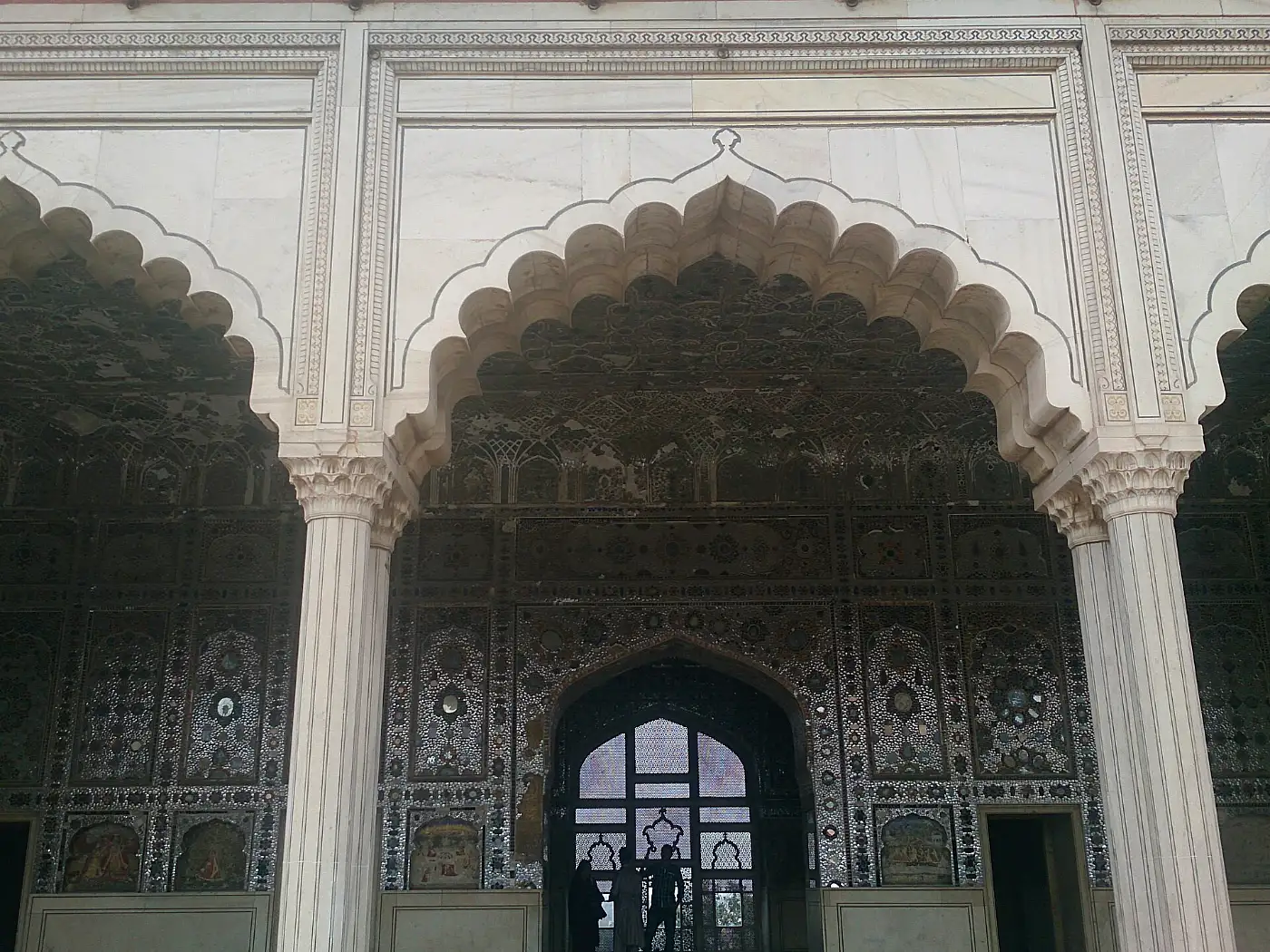
Cusped marble arches on paired columns. Photo Credit: NainaR, CC BY-SA 4.0.
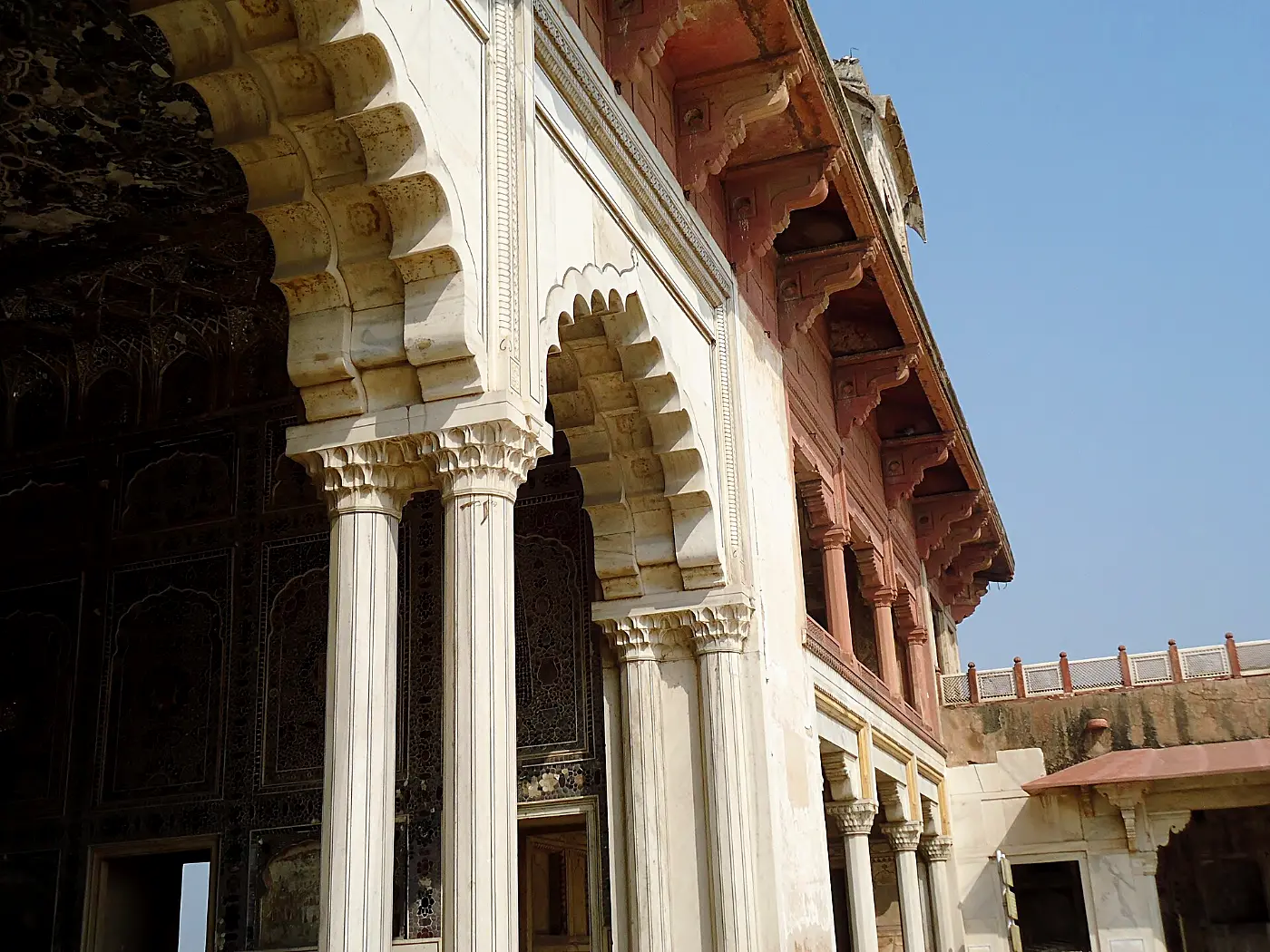
Paired columns along the veranda. Photo Credit: Nahid Asad, CC BY-SA 3.0.
What to See Inside
The Central Mirror Hall
Step into the main hall and look around slowly. Indeed, every wall is covered in mirror mosaic, flowers and geometric stars. Then, at the far end, a carved jali window lets in soft light, and the mirrors scatter it in every direction.
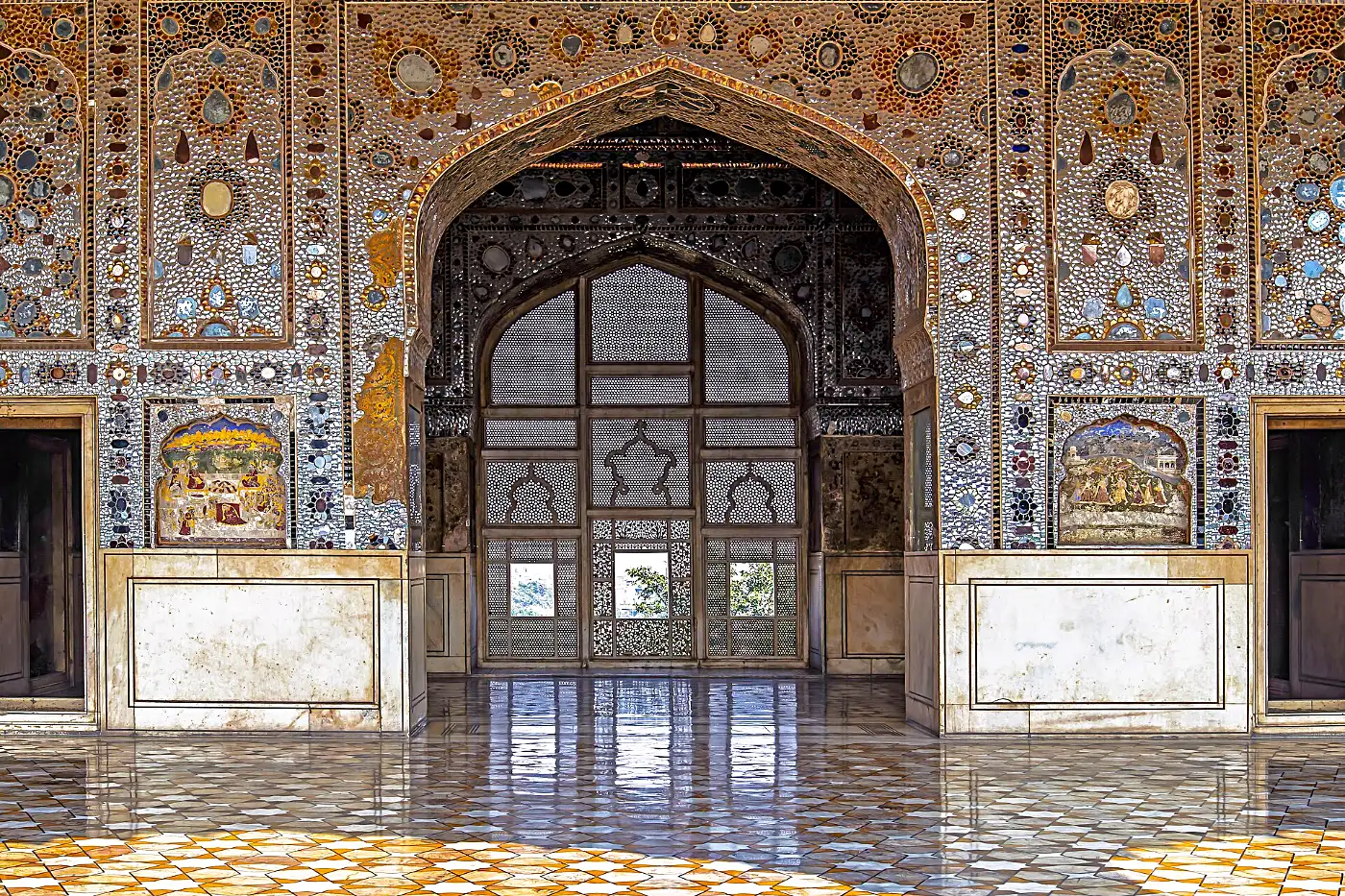
The central hall of the Sheesh Mahal. Photo Credit: Faisalrazamalik, CC BY-SA 4.0.
Ayina Kari: The Mirror Work
Now come closer. In fact, you will see that the walls are made of hundreds of small, star-shaped and round mirror pieces. Besides, each one sits in a bed of plaster, framed by coloured glass. As a result, the surface shimmers even on a cloudy day.
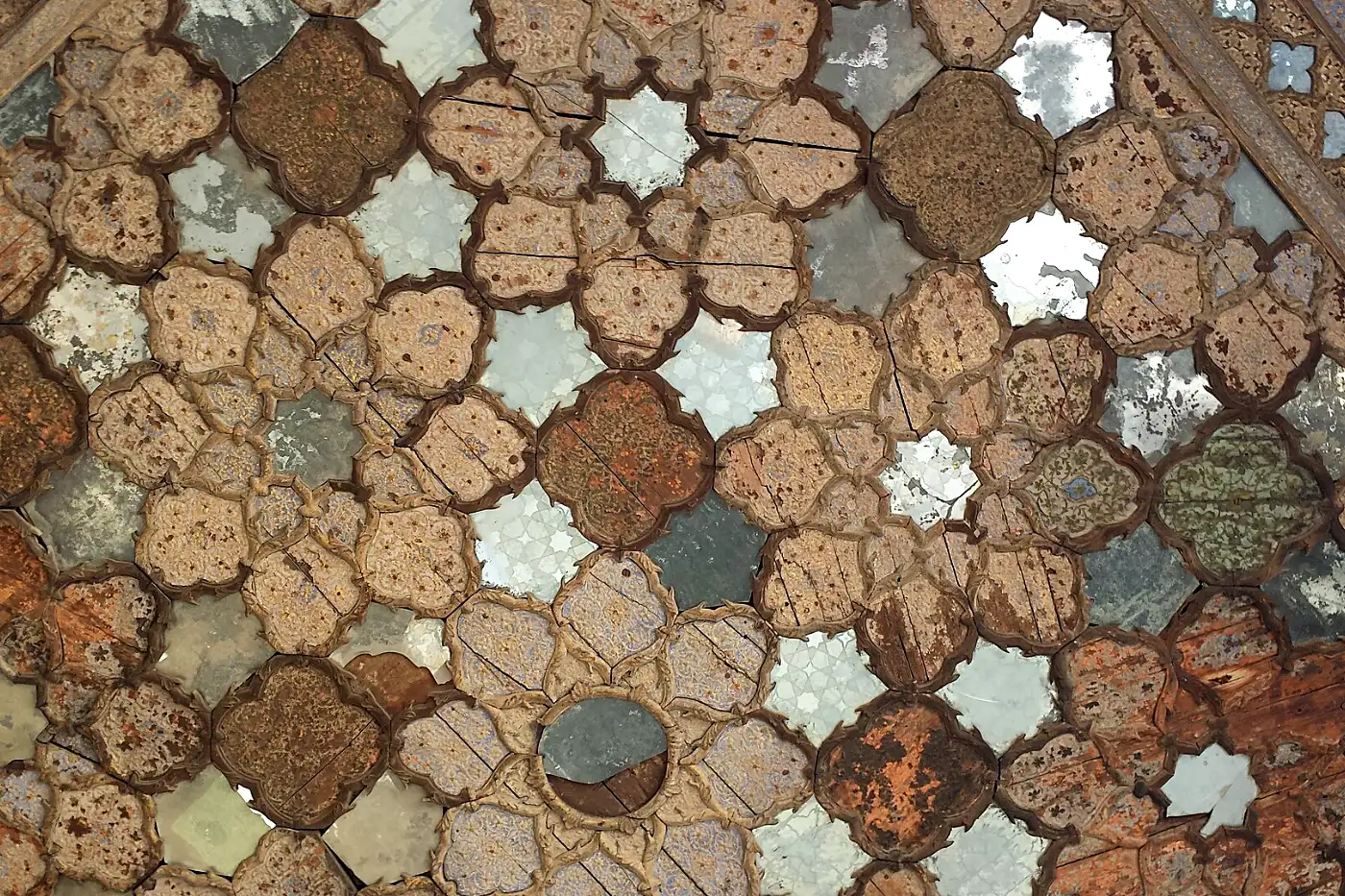
Close-up of the mirror pieces. Photo Credit: Fahad.Journalist, CC BY-SA 4.0.
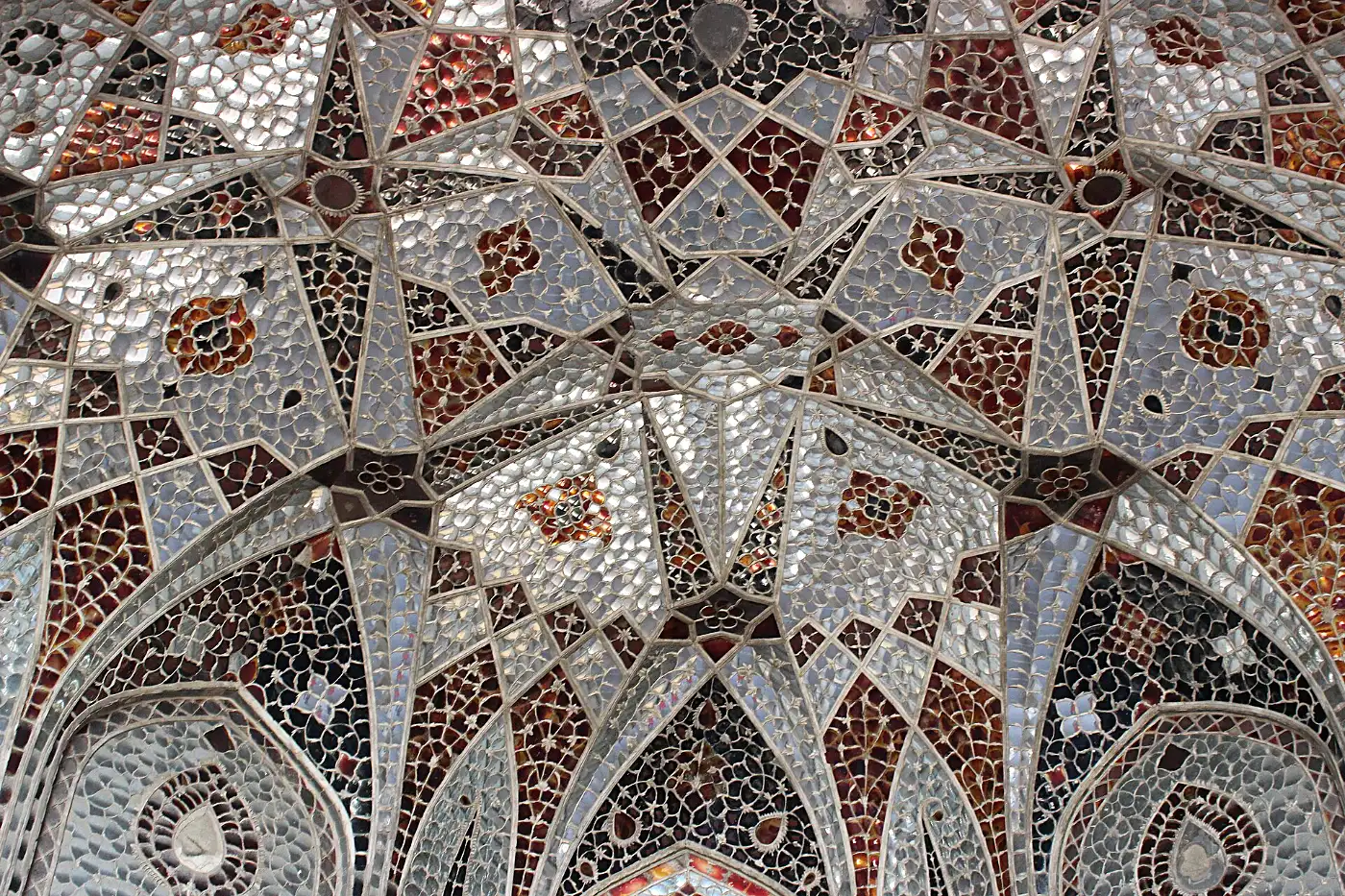
Star patterns in the mirror mosaic. Photo Credit: Aishakhan229, CC BY-SA 4.0.
Ceilings and Marble Screens
Next, look up. The side chambers have vaulted ceilings filled with mirror work, and the original frescoes in the main roof were later replaced with coloured glass mosaic. Meanwhile, carved marble screens and panels frame the windows with tendrils and geometric patterns.
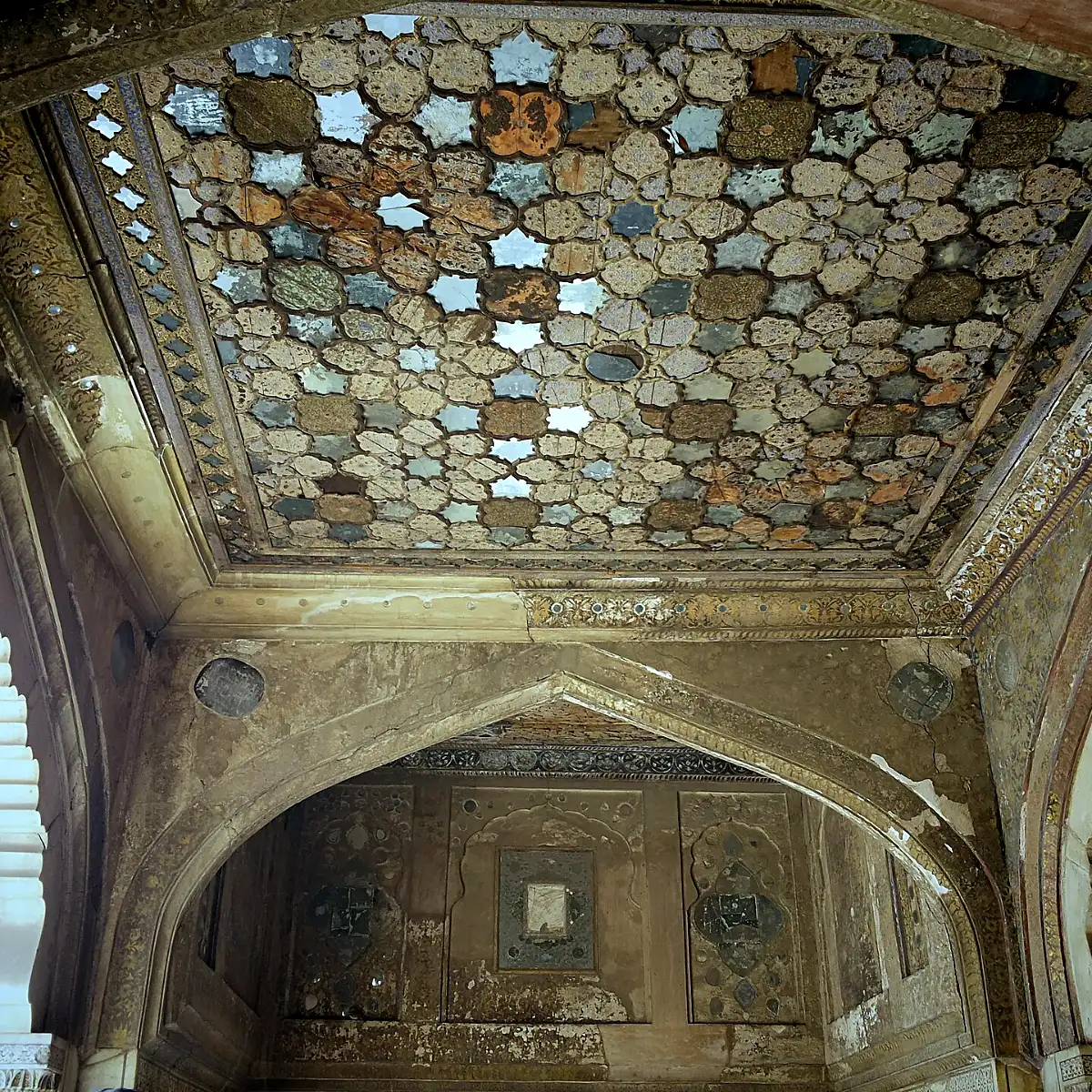
A mirror-work ceiling in a side chamber. Photo Credit: Drdolittle13, CC BY-SA 3.0.
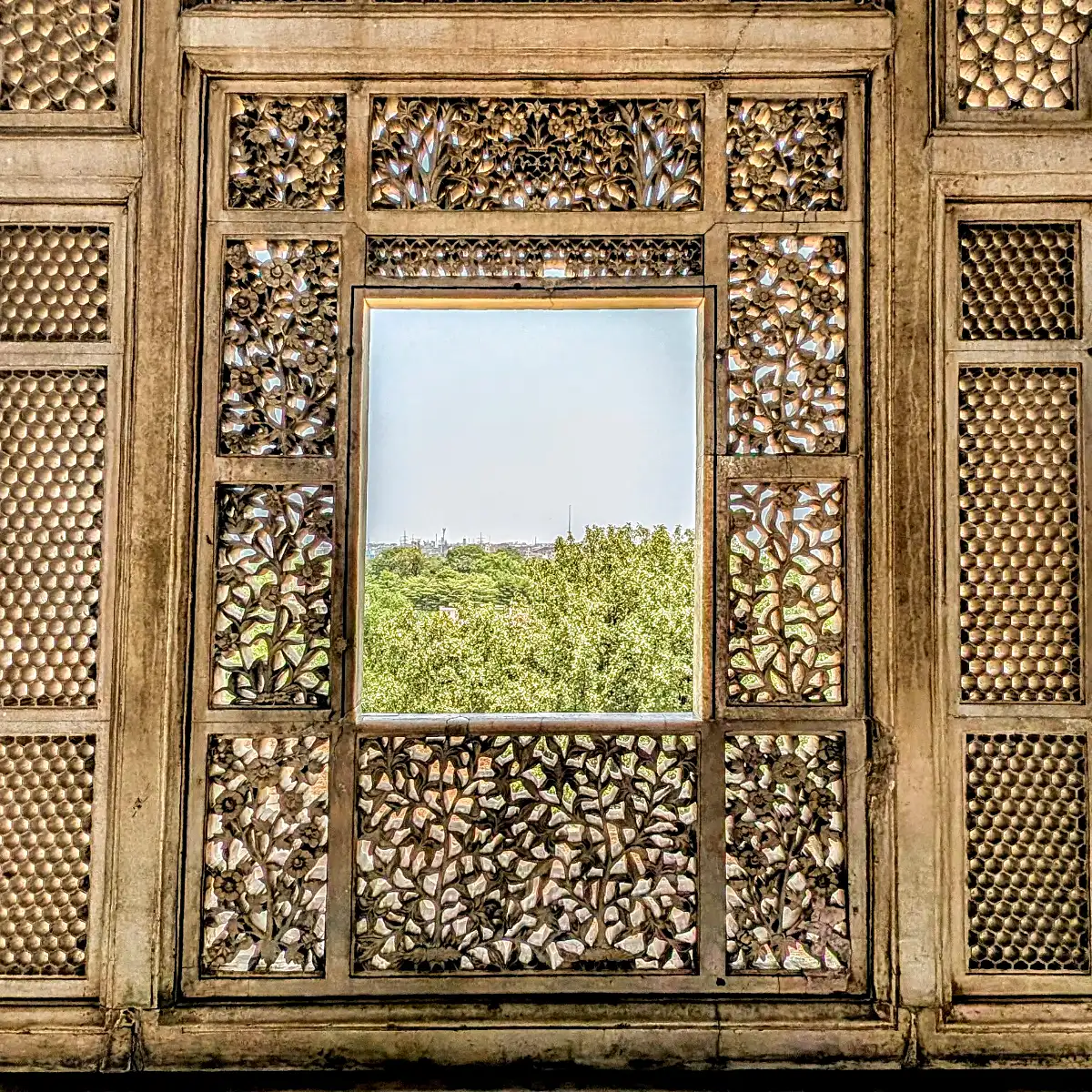
Marble and mirror panels around a window. Photo Credit: Muhammad Umair Mirza, CC BY-SA 4.0.
The Veranda and Painted Panels
Finally, walk along the veranda behind the marble columns. Here, the mirror work continues across the walls. In addition, look for small painted panels between the mirrors, which show later Sikh-era additions to the Mughal design.
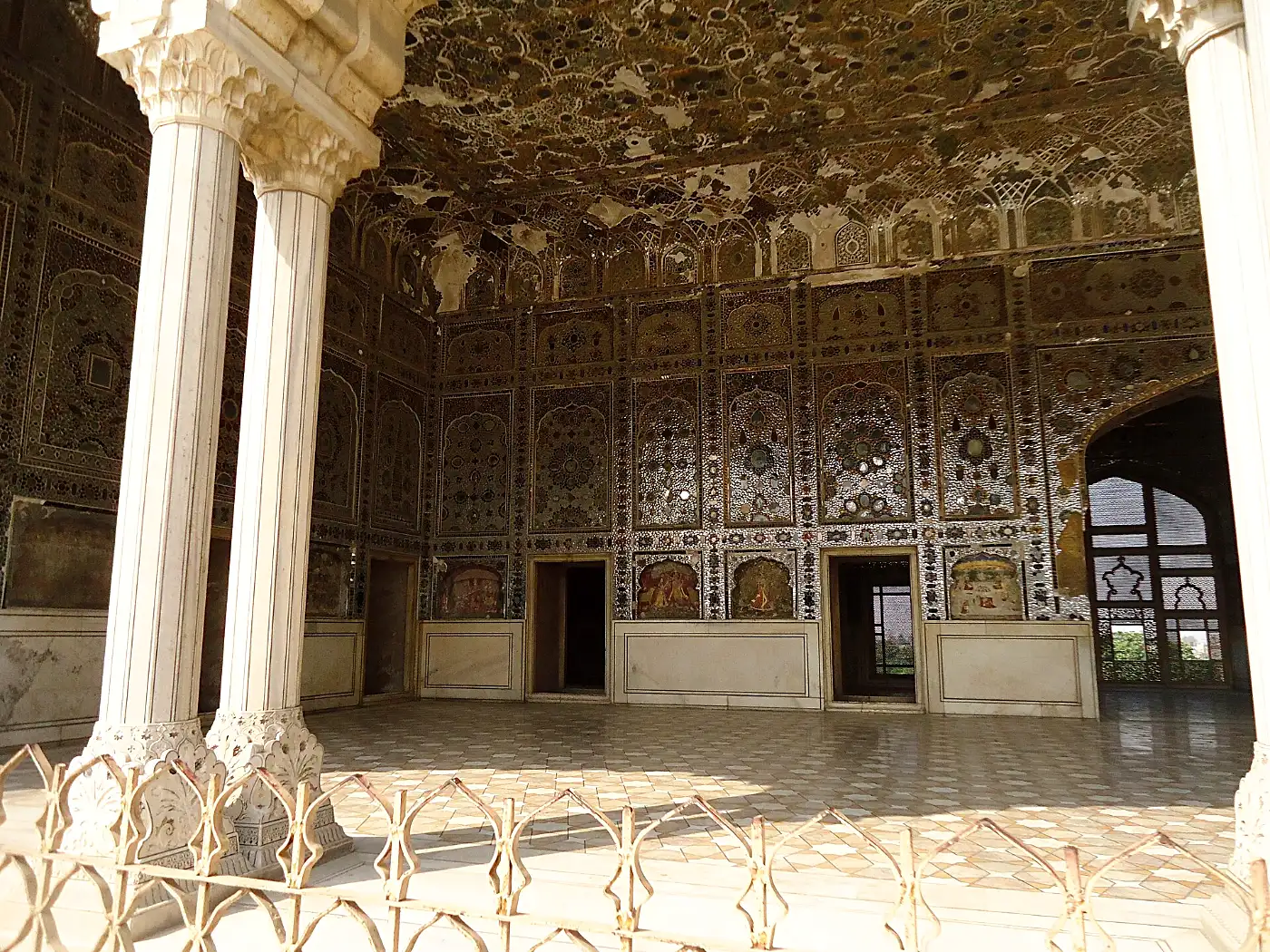
The veranda with marble columns and mirror walls. Photo Credit: Nahid Asad, CC BY-SA 3.0.
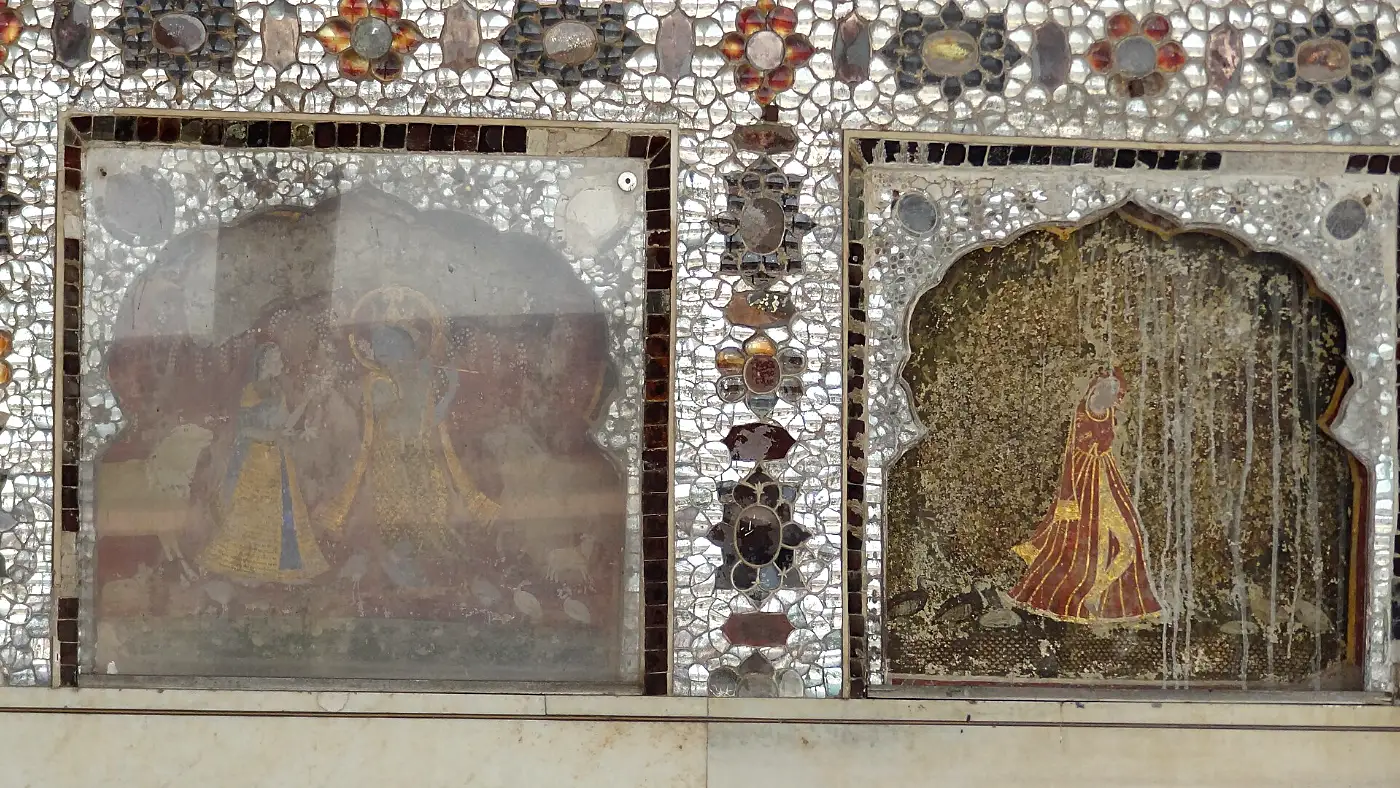
Painted panels among the mirror work. Photo Credit: MJBrohi, CC BY-SA 3.0.
Naulakha Pavilion
On the western side of the Sheesh Mahal courtyard sits the Naulakha Pavilion, a small marble gem from Shah Jahan’s time. Notably, its curved roof copies the shape of a Bengali hut, and its walls are inlaid with tiny stones in floral designs. Furthermore, its name means “nine lakh”, because, according to tradition, it cost nine lakh rupees, a huge sum in those days.
Also, walk to the edge of the pavilion. From here, the Mughal emperors once looked out over the River Ravi, which flowed close to the fort walls in those days.
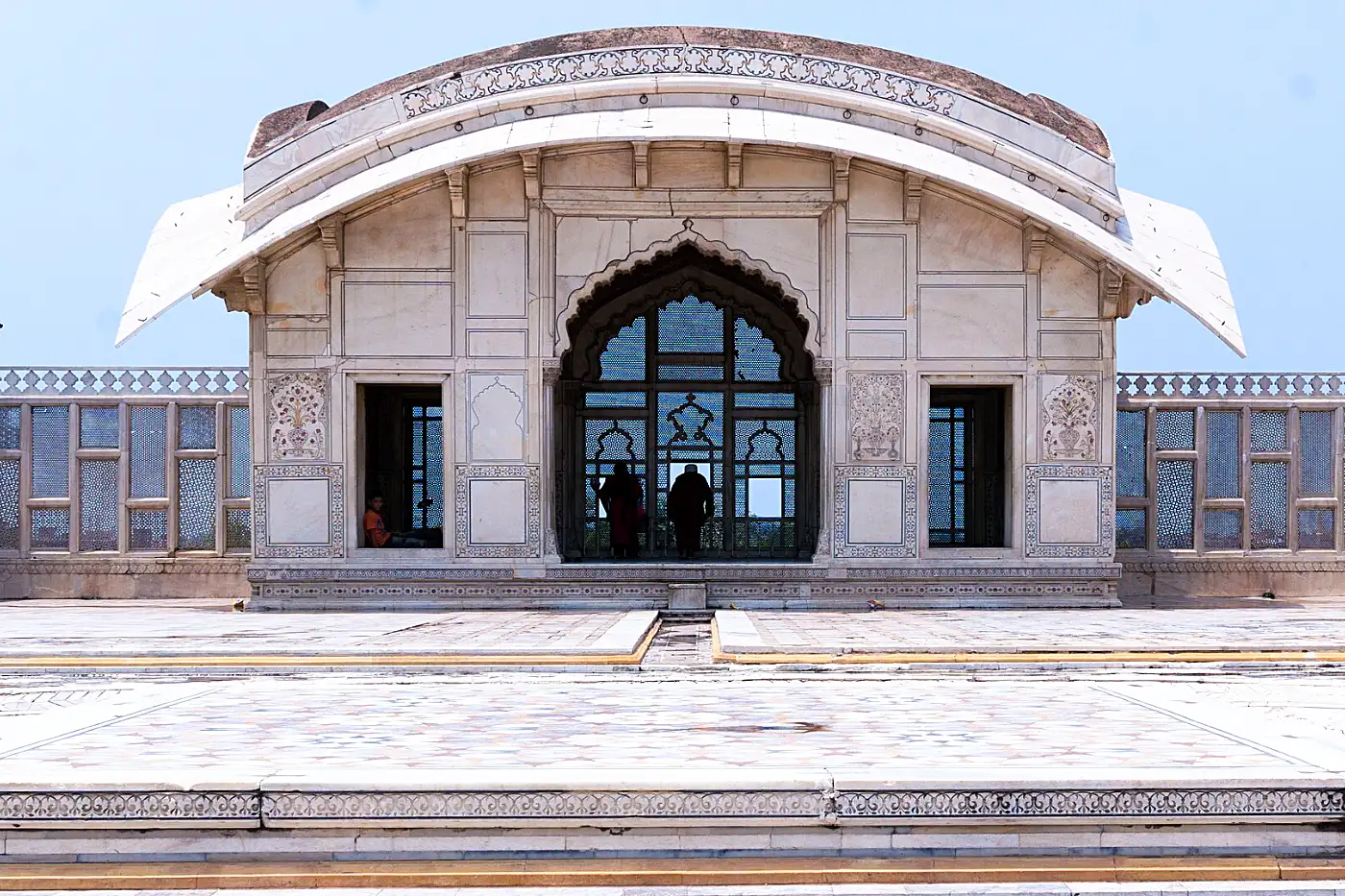
The Naulakha Pavilion from the courtyard. Photo Credit: Jawad.hassan89, CC BY-SA 3.0.
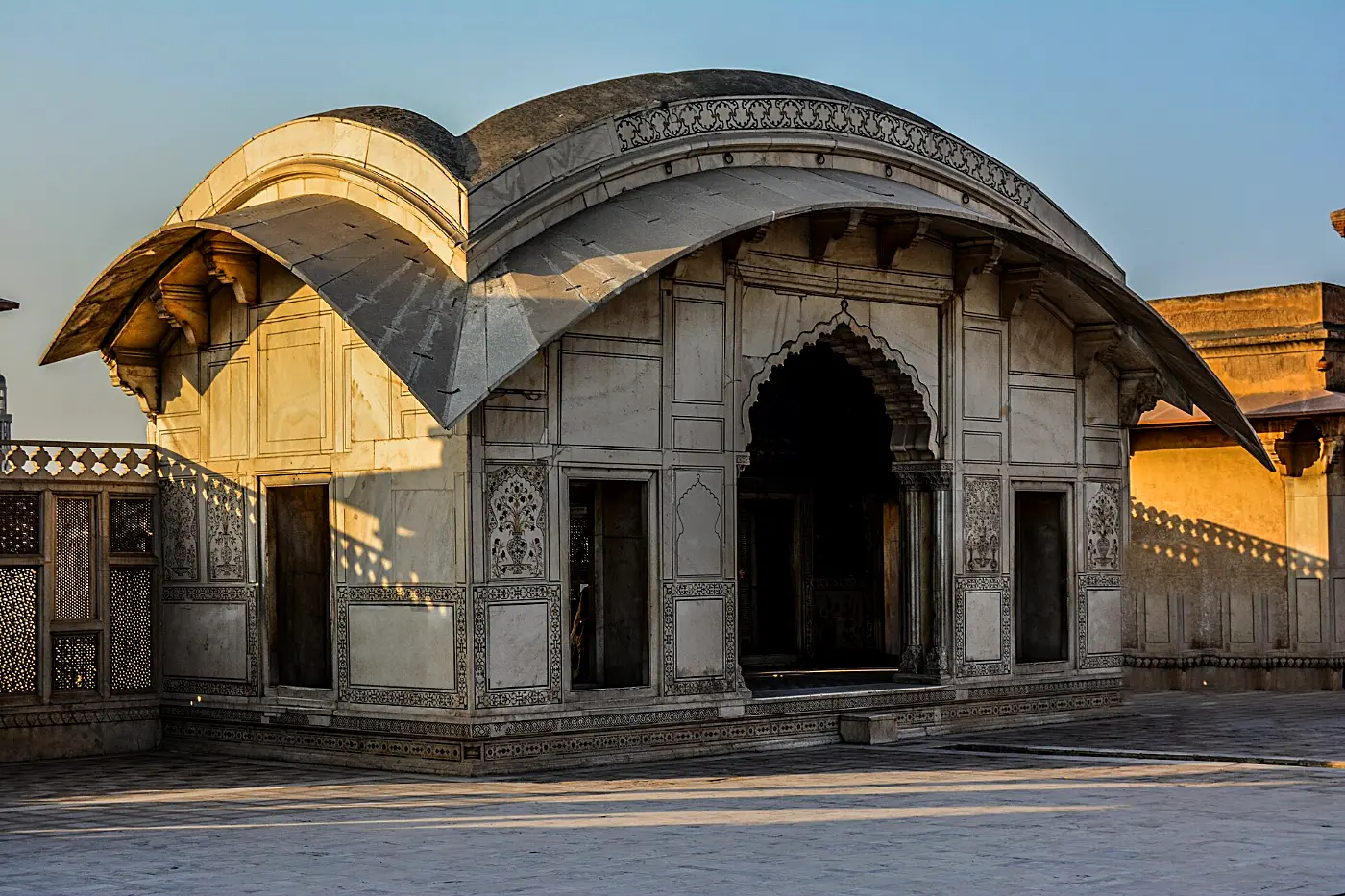
The curved roof of the Naulakha Pavilion. Photo Credit: Faran Shehryar Malik, CC BY-SA 4.0.
Things to Do
- Best moment: Stand in the middle of the main hall and turn slowly to watch the mirrors catch the light.
- Best photo spot: The five marble arches, from the far side of the courtyard.
- Do not miss: The Naulakha Pavilion and its curved marble roof.
- Combine with: The Picture Wall outside the Shah Burj Gate, and the rest of the Lahore Fort.
- Night tour: Book an evening visit to see the palace lit up.
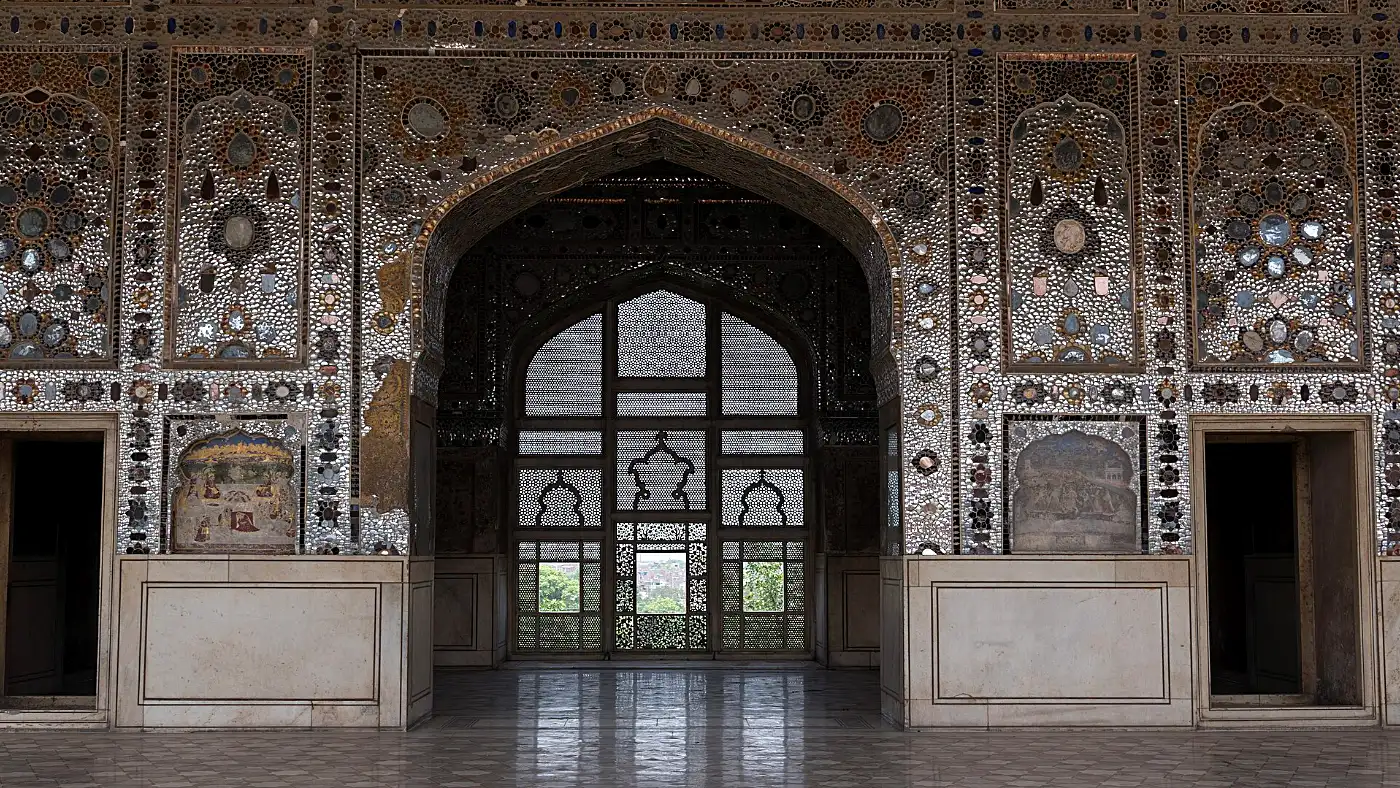
Mirror-covered walls around the jali window. Photo Credit: Jawad.hassan89, CC BY-SA 3.0.
Food Nearby
After your visit, head to Fort Road Food Street, just outside the fort and the Badshahi Mosque. There, rooftop restaurants serve karahi, tikka, nihari and fresh naan with a view of the mosque domes. In addition, the lanes of the Walled City have cheaper places for halwa puri, lassi and chai. Expect to pay around PKR 500 to 1,500 per person at small eateries, and more at the rooftop restaurants.
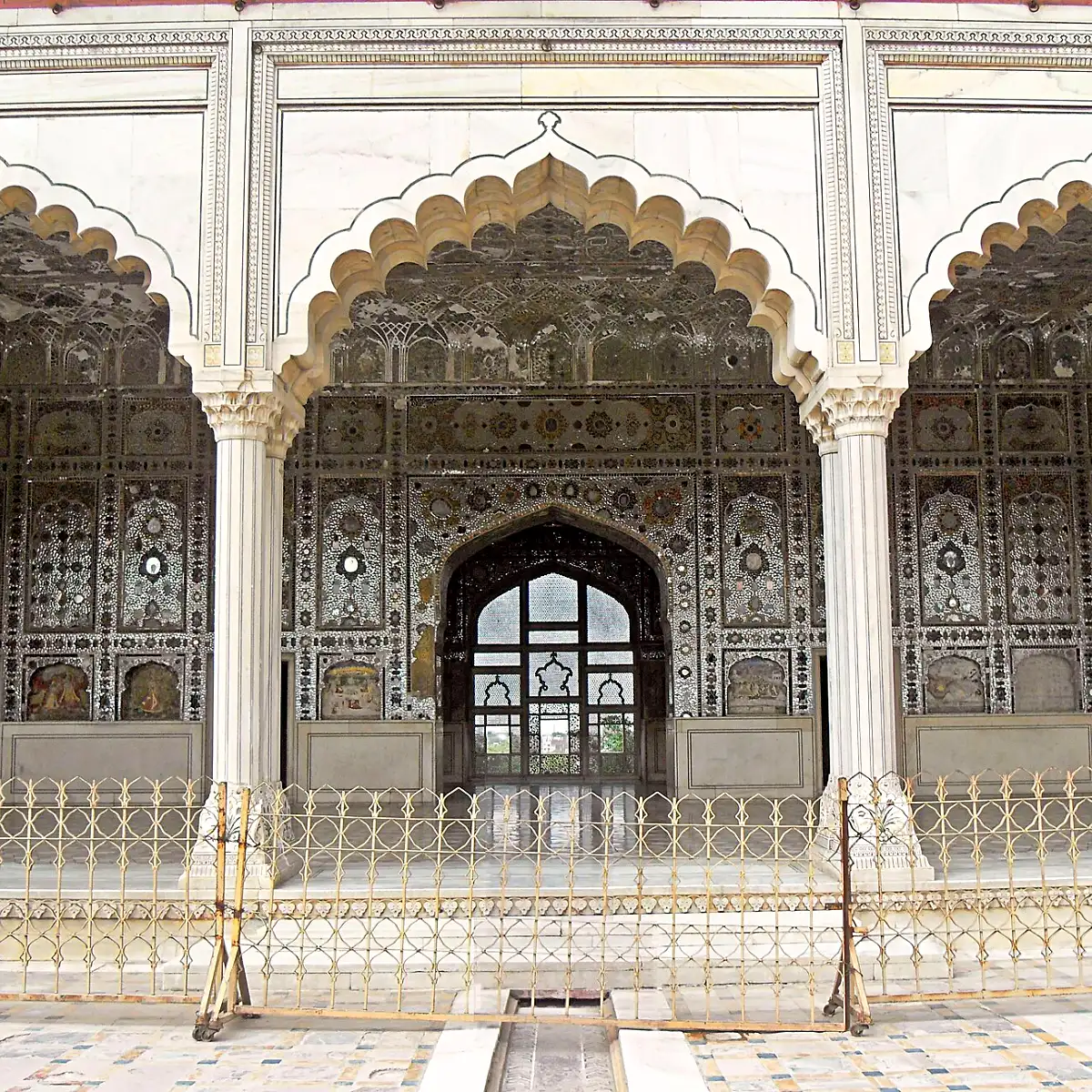
Mirror work and cusped arches of the Sheesh Mahal. Photo Credit: Farrah Zakir, CC BY-SA 4.0.
Visitor Information
Visiting Sheesh Mahal Lahore
- Location: Shah Burj block, north-western corner of Lahore Fort, Walled City, Lahore.
- Timings: The fort usually opens daily from about 8:30 am to 5:30 pm, but the Sheesh Mahal may close earlier. Check before you go.
- Tickets: You buy a Lahore Fort ticket, and the Sheesh Mahal often needs a separate ticket. Prices change, so check at the counter or on the Walled City of Lahore Authority website.
- Night tours: In October 2026, the Walled City of Lahore Authority announced evening visits that include the Sheesh Mahal, at PKR 1,000 for Pakistani adults, PKR 500 for children aged 3 to 10 and PKR 2,000 for foreigners.
- Best time: November to March, and early morning when the light is soft and crowds are thin.
- Time needed: About 30 to 45 minutes for the Sheesh Mahal, or 3 hours for the whole fort.
- Photography: Phone photos are fine, but do not use flash or touch the mirror work.
- Accessibility: The Shah Burj area has steps and uneven floors, so it is hard for wheelchairs and elderly visitors.
- Families and women: It is a safe, family-friendly place with guards on duty.
Last checked: November 2026. Timings and prices can change, especially in Ramadan and on public holidays.
Also, restoration work is ongoing, so parts of the hall may be closed for a while. Still, the courtyard and the arches are usually open.
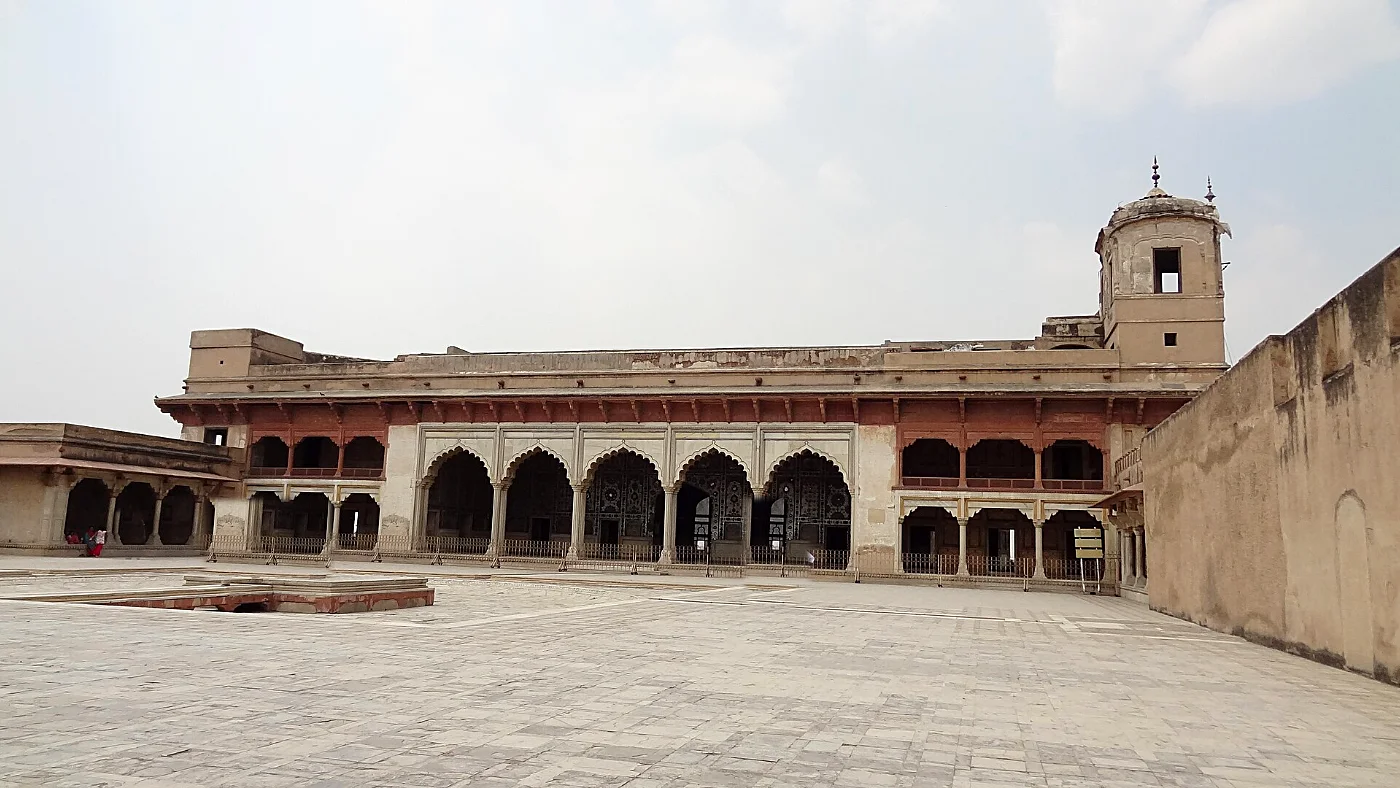
The Sheesh Mahal quadrangle and the Shah Burj. Photo Credit: MJBrohi, CC BY-SA 3.0.
How to Get There
The Sheesh Mahal is inside the Lahore Fort, next to the Badshahi Mosque in the old city. First, take a rickshaw, Careem or inDrive to the fort’s main entrance near Hazuri Bagh. Alternatively, ride the Metro Bus to Azadi Chowk and walk about 15 minutes past Minar-e-Pakistan. Once inside, follow the signs north-west past the Diwan-e-Aam to the Shah Burj. Overall, the walk inside the fort takes around 10 to 15 minutes.
You can also join the Punjab Tourism sightseeing bus, which stops at the fort on its city tour.
Places to Visit Nearby
- Lahore Fort: the whole Shahi Qila, with the Diwan-e-Aam, Moti Masjid and Picture Wall.
- Badshahi Mosque: the grand Mughal mosque right across Hazuri Bagh.
- Hazuri Bagh: the marble baradari garden between the fort and the mosque.
- Samadhi of Ranjit Singh: the golden-domed memorial of the Maharaja who loved the Sheesh Mahal.
- Gurdwara Dehra Sahib: a Sikh shrine just outside the fort walls.
- Tomb of Allama Iqbal: the poet’s red sandstone tomb by the mosque steps.
- Minar-e-Pakistan: the national monument in Greater Iqbal Park, a short walk away.
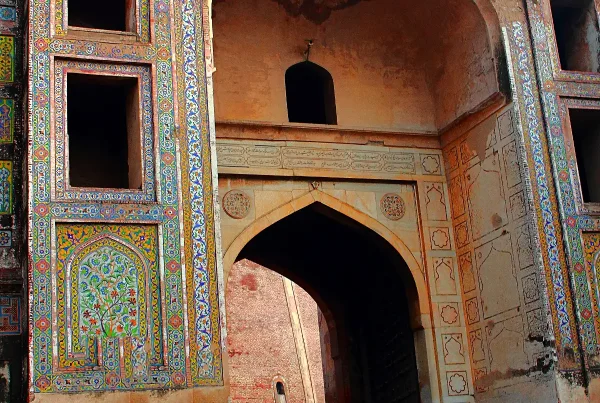
- Picture Wall: the giant Mughal tile mural on the outer walls, just outside the Shah Burj.
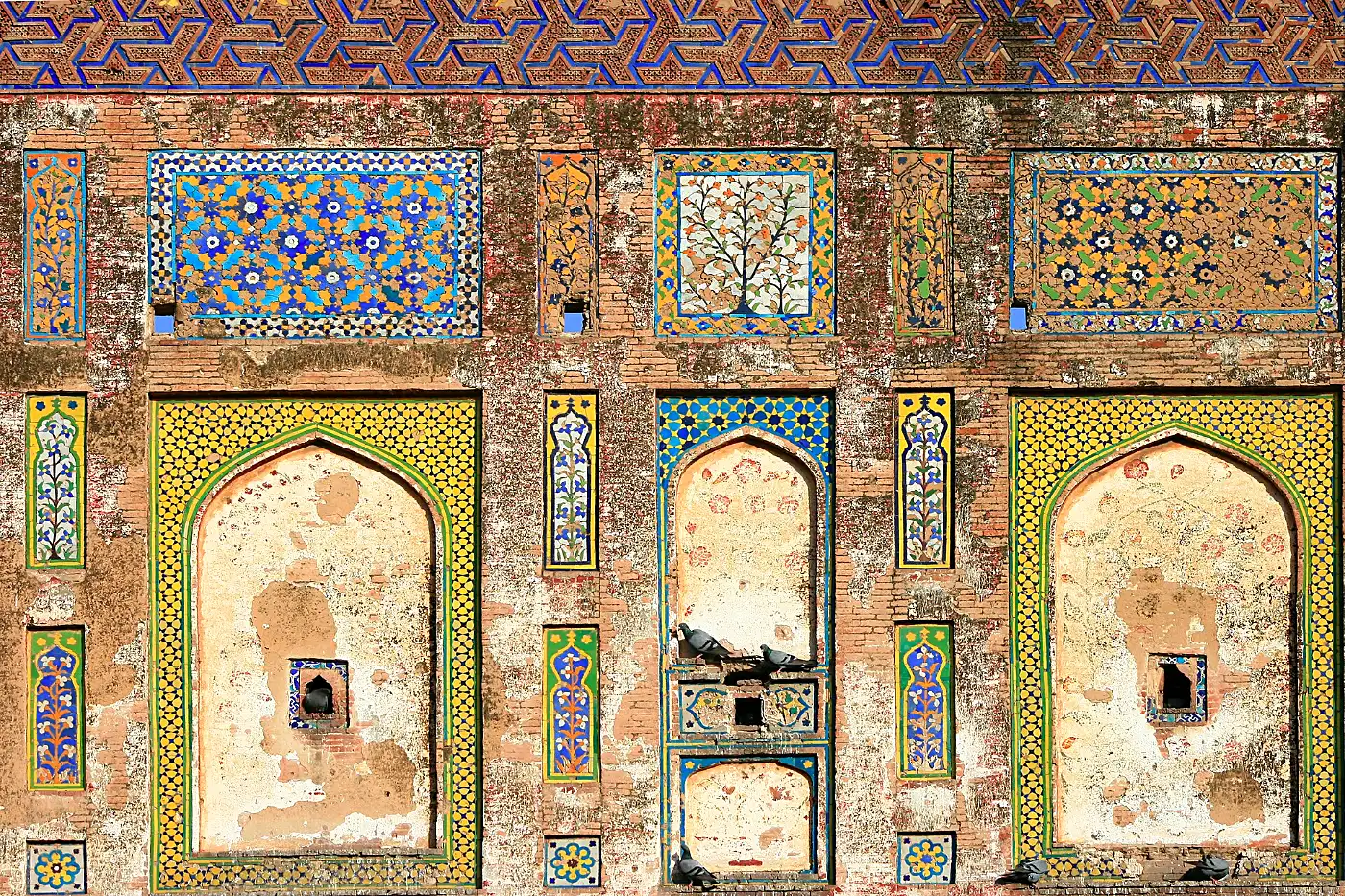
The tiled Picture Wall outside the Shah Burj Gate. Photo Credit: Aliraza Khatri, CC BY-SA 4.0.
Frequently Asked Questions
Who built Sheesh Mahal Lahore?
In short, Mughal Emperor Shah Jahan built it in 1631-32, inside the Shah Burj block that his father Jahangir had started.
Is there a separate ticket for Sheesh Mahal Lahore?
Often, yes. You usually need a Lahore Fort ticket plus a small extra ticket for the Sheesh Mahal. Since prices change, check at the counter.
Can I visit the Sheesh Mahal at night?
Yes. The Walled City of Lahore Authority runs evening tours of the fort that include the Sheesh Mahal, the Picture Wall and Hazuri Bagh.
Is the Sheesh Mahal open on Fridays?
The fort usually opens every day, including Fridays. However, timings can change during Ramadan and on special days, so check before you go.
How long does it take to see the Sheesh Mahal?
About 30 to 45 minutes. However, plan for three hours if you want to see the whole fort too.
Conclusion
The Sheesh Mahal Lahore is small, but it leaves a big impression. In just a few rooms, moreover, you see Mughal luxury, Sikh history and the moment the British took the Punjab. So, when you visit the Lahore Fort, keep enough time and energy for its north-western corner. Above all, go early, stand in the mirror hall, and let the light do the rest.
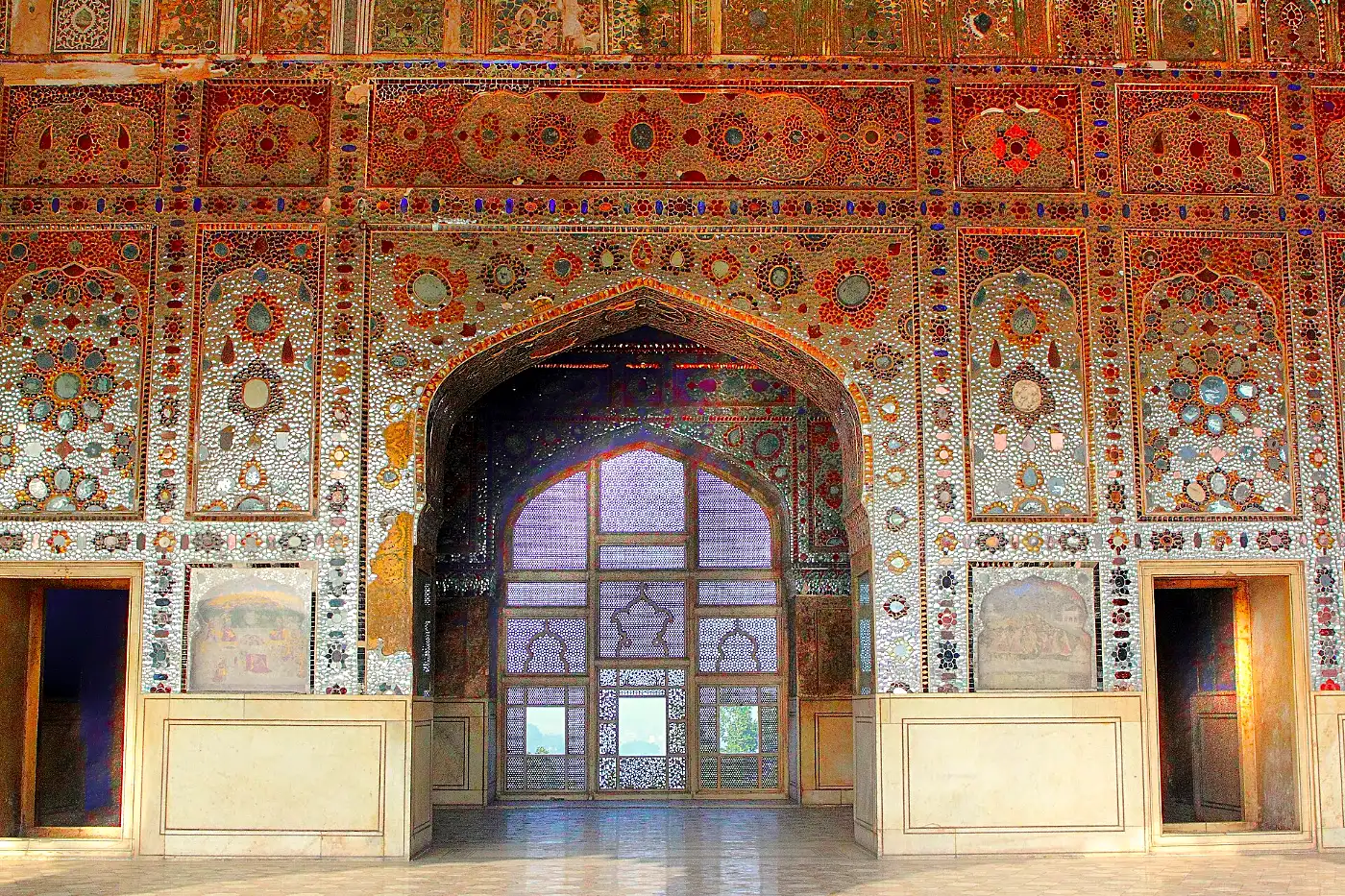
The mirror hall glowing in warm light. Photo Credit: ClicksByMohammadOmer, CC BY-SA 3.0.
Cover photo: Faizanahmad, CC BY-SA 4.0.