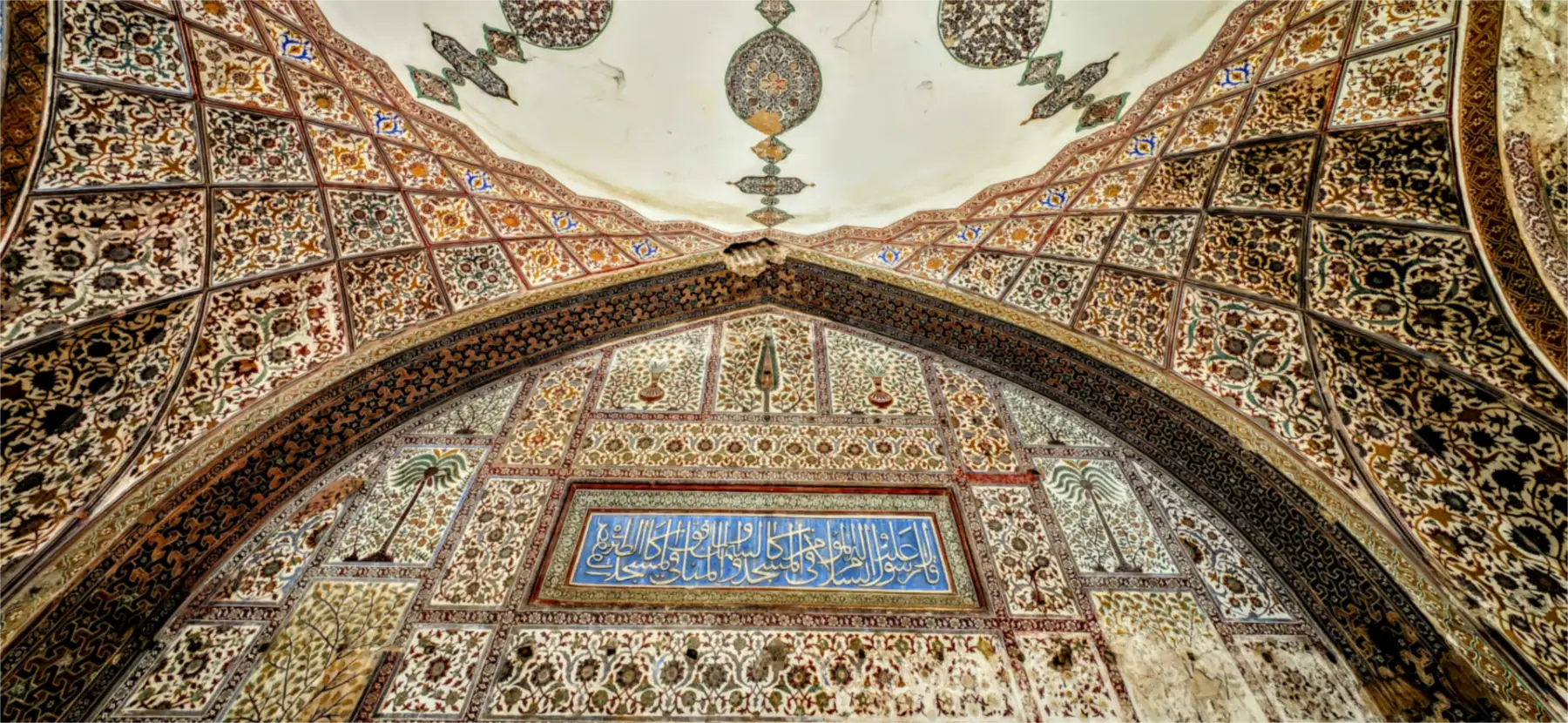
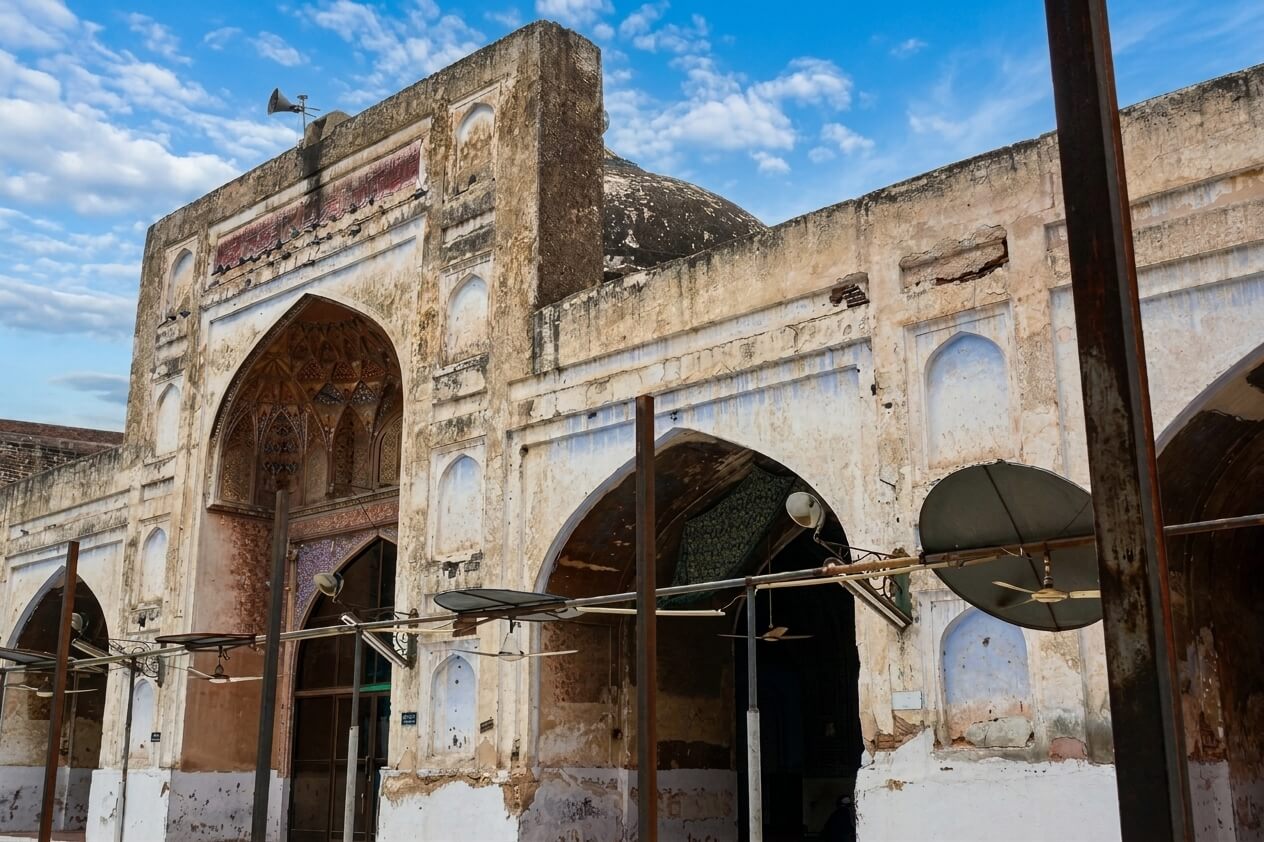
Walk in through Masti Gate, squeeze past the tyre shops of Rim Market, and you reach a small brick mosque that most people walk right past. Yet inside, every arch and dome is covered in paint. This is Maryam Zamani Mosque Lahore, also called Begum Shahi Masjid, and it is the oldest dated Mughal mosque in the city.
Builders finished it in 1614, long before the famous Wazir Khan and Badshahi mosques. In fact, both of them borrowed ideas from it. So if you love old Lahore, this quiet mosque deserves a slow visit. In this guide, we cover its story, what to look for inside and how to reach it.
History of Maryam Zamani Mosque
The mosque carries the name of Mariam-uz-Zamani, a wife of Emperor Akbar and the mother of Emperor Jahangir. She was born a Rajput princess. Her title means “Mary of the Age”, while Begum Shahi roughly means “the royal queen”. That is why Lahoris use both names today.
Work started in 1611, early in Jahangir’s reign. Then, in 1614, the builders finished it. A Persian inscription on the northern gateway records the date as 1023 AH and names the empress as the founder. Another inscription, on the eastern gateway, carries her prayer for her son Jahangir.
Why Maryam Zamani Mosque Lahore Matters
For more than 200 years, nobles and ordinary people prayed here. It was the main mosque for anyone visiting the royal court in the fort across the road. Later, however, the bigger Wazir Khan Mosque took over as the city’s main Friday mosque.
Gunpowder Mosque and Return
Under Maharaja Ranjit Singh, the building became a gunpowder factory. As a result, people started calling it the Barudkhana Wali Masjid, or the Gunpowder Mosque. Finally, in 1850, the British deputy commissioner of Lahore handed it back to the Muslims, along with its shops and houses.
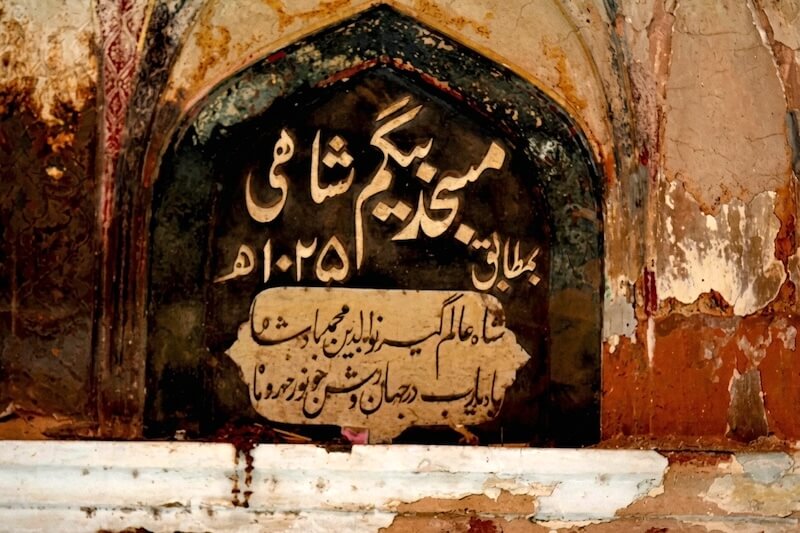
The old inscription naming Masjid Begum Shahi. Photo Credit: The Walled City of Lahore Authority, CC BY-SA 4.0.
Architecture of Begum Shahi Masjid
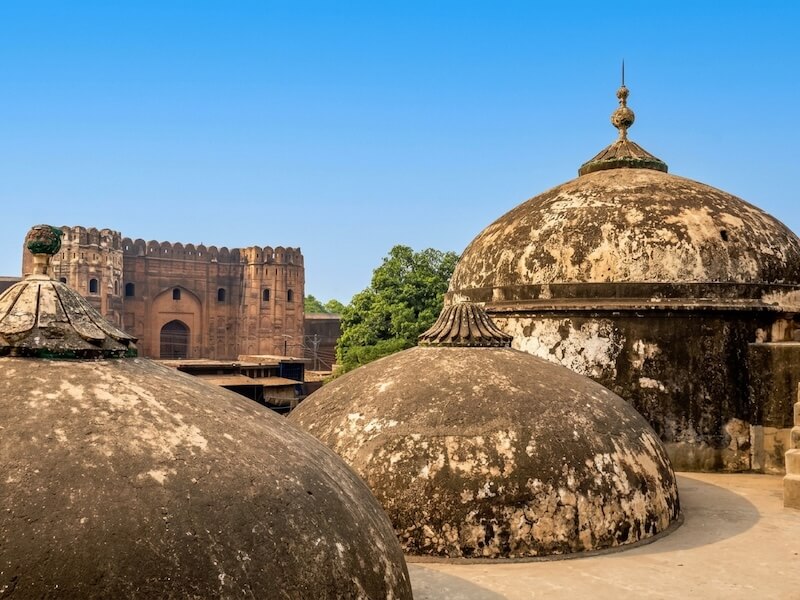
At first glance, the mosque looks simple. It is built of brick and covered in plaster, with a wide courtyard in front of a long prayer hall. However, look closer and you will see why historians call it a bridge between two styles.
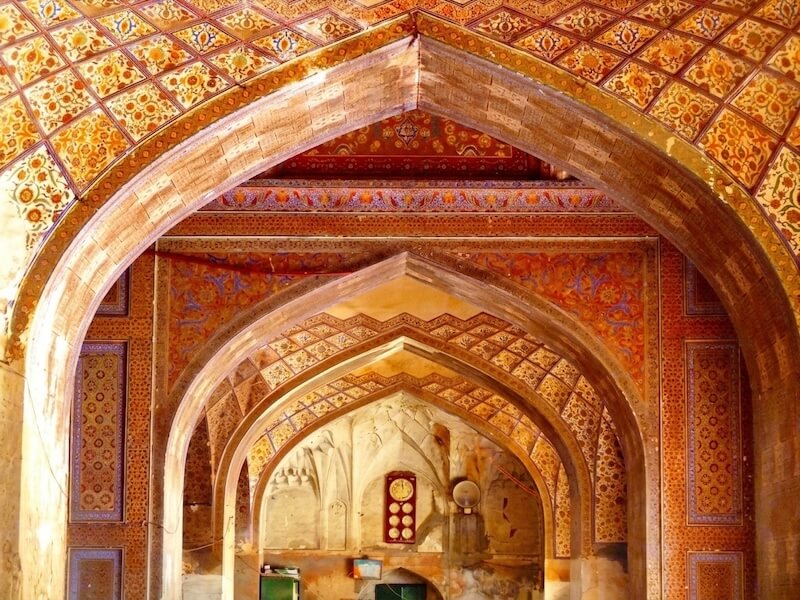
For example, the short domes and wide arches come from the older Lodi style of Delhi. Meanwhile, the balconies, side rooms and rich decoration are purely Mughal. The prayer hall has five bays in a single row, with a larger central bay and smaller domes on each side. This was the first five-bay prayer hall in Lahore. Later, Wazir Khan Mosque and Badshahi Masjid used the same plan on a much bigger scale.
Also notice that there are no tall minarets. Instead, short towers stand at the corners, so the mosque sits low among the houses of the old city.
What to See at Maryam Zamani Mosque
The Frescoes of Maryam Zamani Mosque Lahore
The frescoes are the real reason to come. Painters covered the entire prayer hall with geometric stars, flowers, vases and vines, painted on wet lime plaster. The British archaeologist Mortimer Wheeler once said these paintings had no rival in Pakistan, and perhaps not even in India.
Next, look up at the main dome. There, a stucco medallion spreads out like a star inside a net. Later Mughal buildings repeated this design, including the painted ceilings of the tomb of Itimad-ud-Daula in Agra.
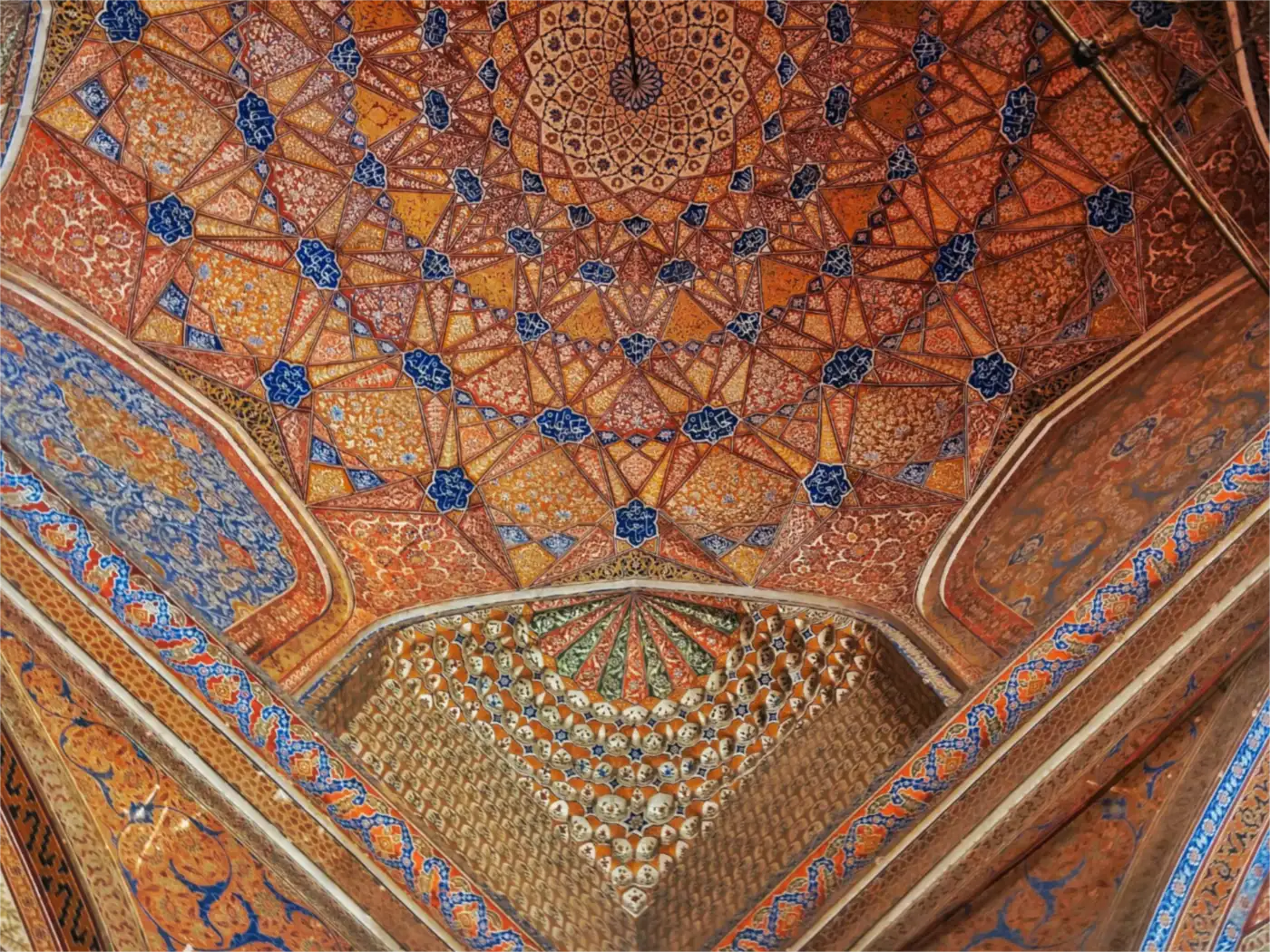
Fresco work on the roof. Photo Credit: Ibrahim Janjua, CC BY-SA 4.0.
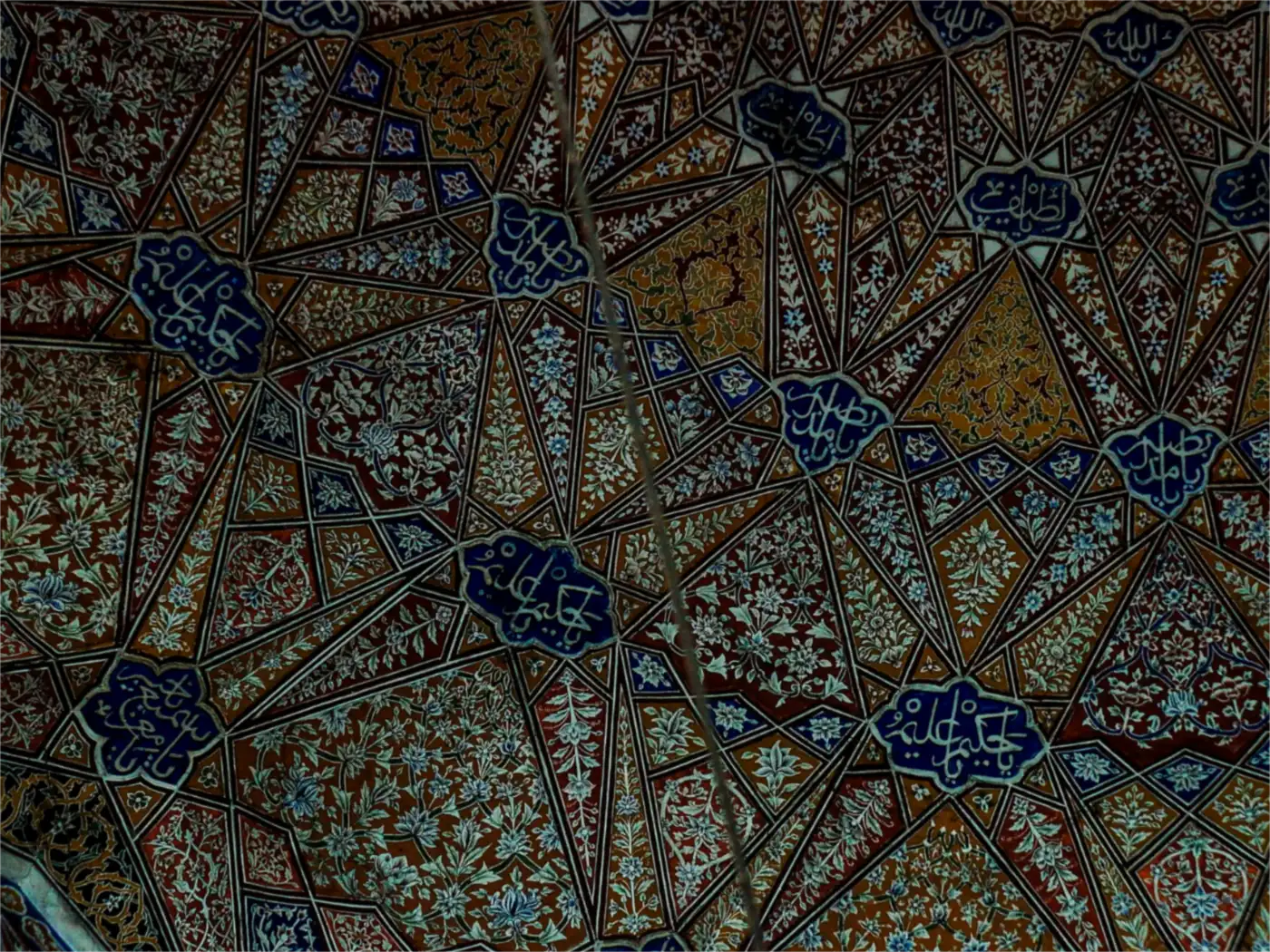
A star-patterned painted ceiling. Photo Credit: Asif Nawaz, CC BY-SA 3.0.
Muqarnas Vaults
Next, find the corners where the walls meet the domes. Here the builders used muqarnas, small honeycomb-like niches stacked in rows. They are painted in orange, blue, green and white, and they almost look like jewellery. Bring a phone with a good zoom, because the details are tiny.
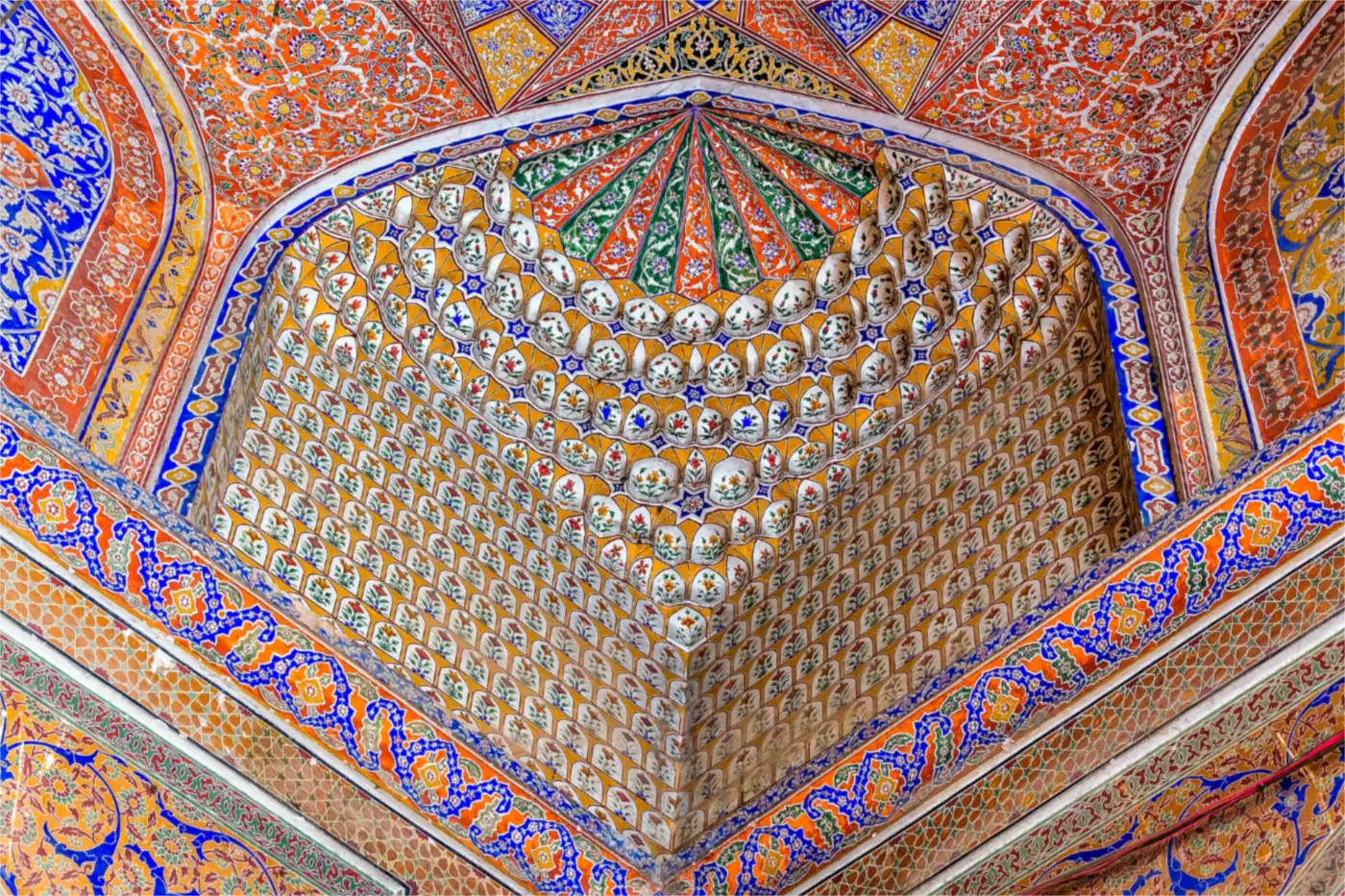
A painted muqarnas corner. Photo Credit: Muhammad Ashar, CC BY-SA 3.0.
Calligraphy and Gateways
In total, the mosque has four inscriptions, some from the Quran and some in Persian. Above one archway, a blue panel carries a saying of the Prophet (PBUH) that compares the faithful in a mosque to fish in water.
Of the original three gateways, two survive, on the north and east sides. Each one is a deep arch with steps going down into the courtyard. In addition, the inner arches are painted just as richly as the prayer hall, so do not rush past them.
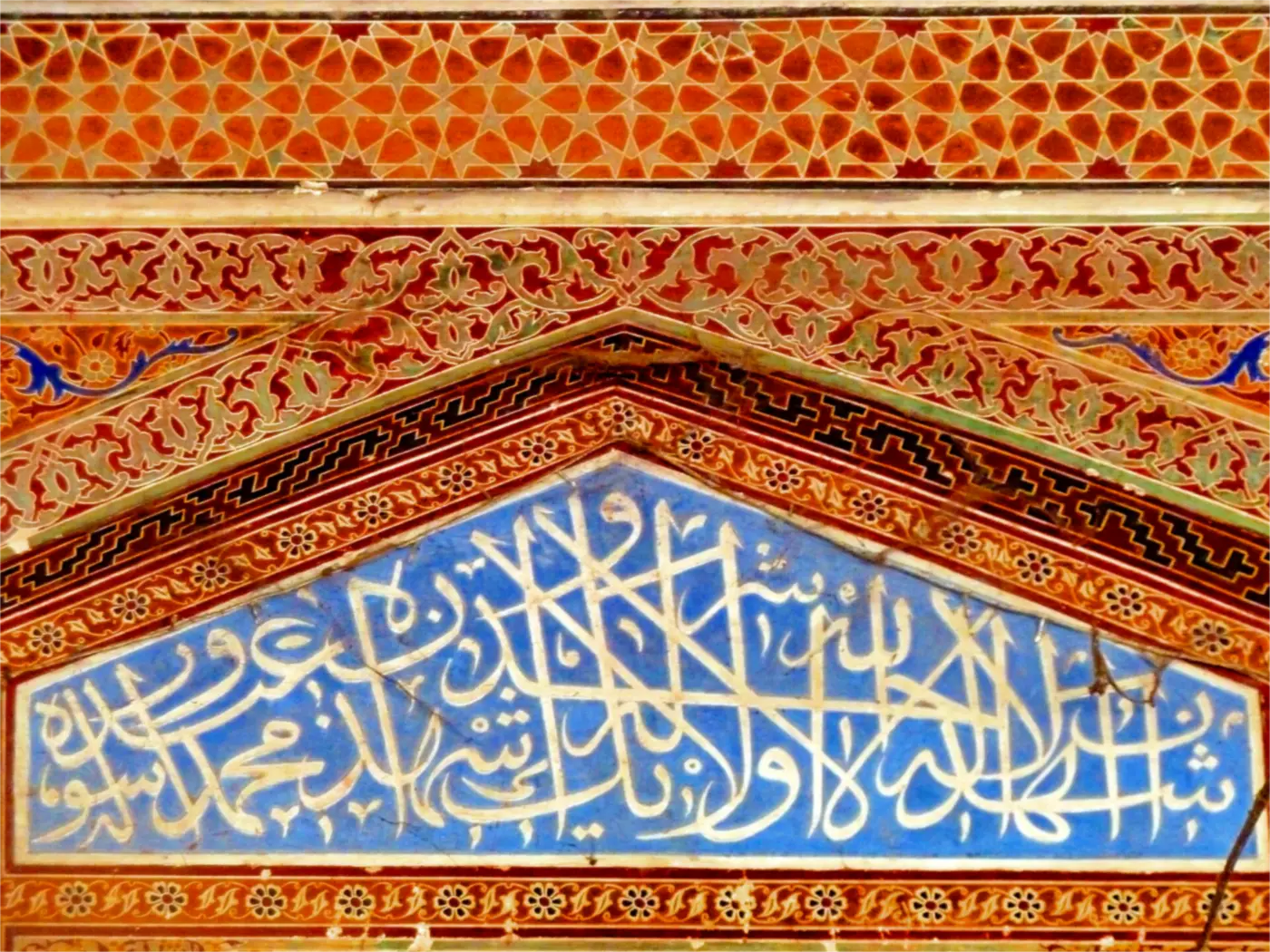
Calligraphy panel inside the mosque. Photo Credit: Musab Bin Noor, CC BY-SA 3.0.
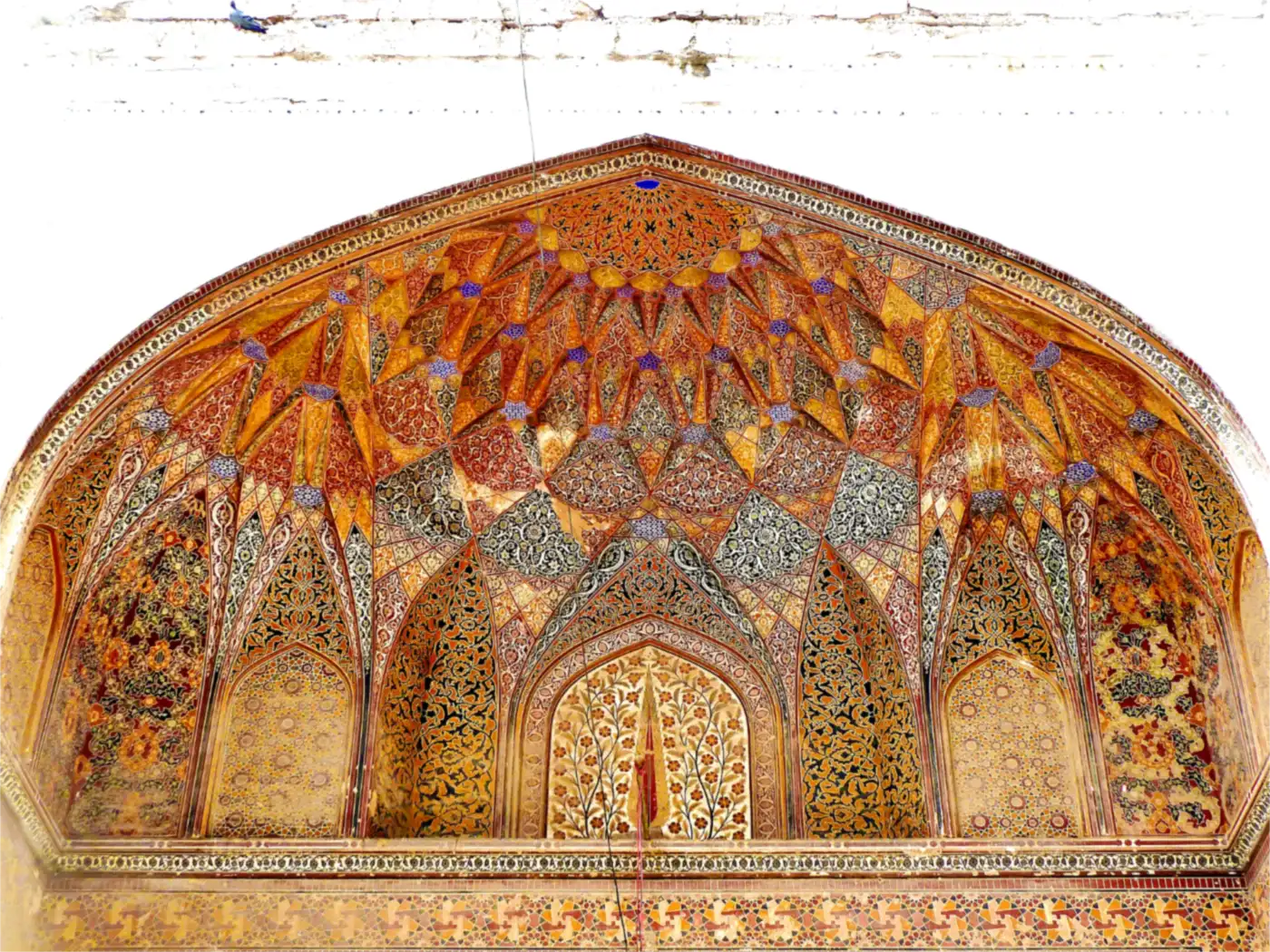
An ornate painted arch. Photo Credit: Musab Bin Noor, CC BY-SA 3.0.
The Courtyard and Ablution Tank
Out in the open, the courtyard measures roughly 37 by 25 metres. In the middle sits a large ablution tank with a fountain, now under a modern canopy. On the east side, you will also see a small enclosure with an octagonal domed tomb and a few graves.
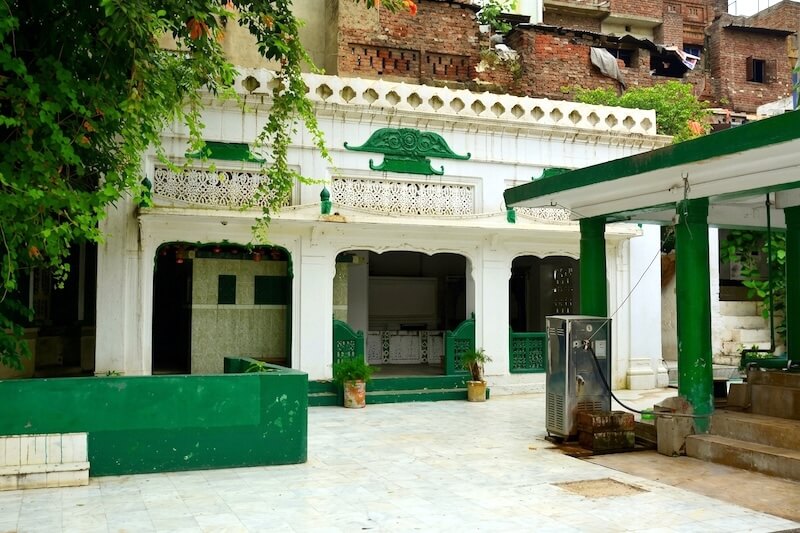
The courtyard and ablution area. Photo Credit: The Walled City of Lahore Authority, CC BY-SA 4.0.
Things to Do
- Sit quietly in the prayer hall and study the ceiling patterns one bay at a time.
- Find the inscription with the date 1023 AH on the northern gateway.
- Photograph the muqarnas corners in soft morning light.
- Compare the frescoes with those of Wazir Khan Mosque on the same day.
Most of all, walk the Royal Trail (Shahi Guzargah). This old Mughal route runs about 1.6 km from Delhi Gate to Masti Gate. So you can start at Delhi Gate, pass the Shahi Hammam, Wazir Khan Mosque and Sunehri Masjid, and then end your walk here.
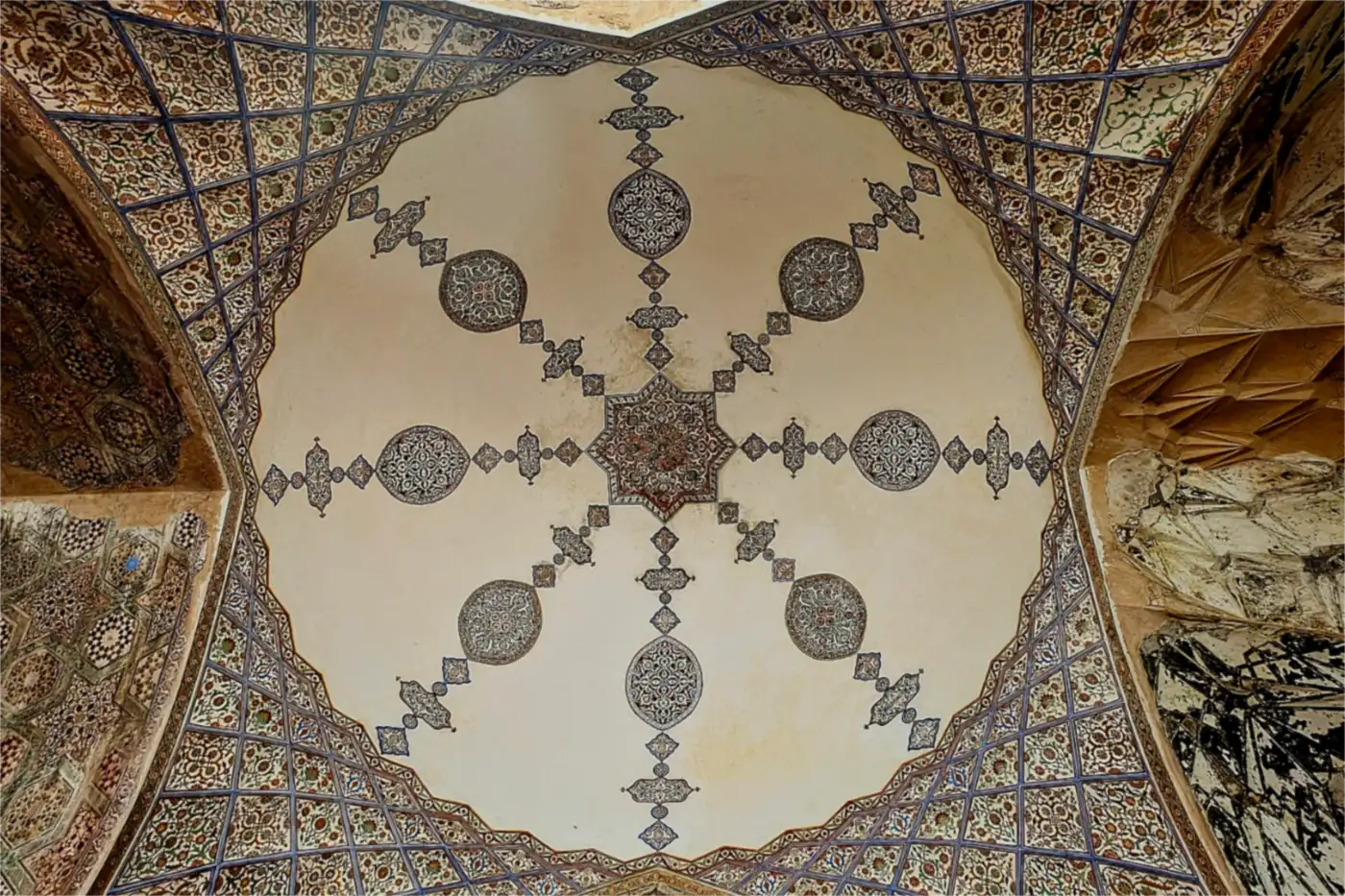
Painted medallions on a dome ceiling. Photo Credit: Muhammad Umair Mirza, CC BY-SA 4.0.
Food Nearby
Of course, the old city is one of the best places to eat in Lahore. For breakfast, try siri paye, halwa puri or nihari at the old shops around Taxali Gate and Lohari Gate. Meanwhile, Akbari Mandi, the city’s old spice market, is close by, and it is fun to walk through.
In the evening, head to Fort Road Food Street near Badshahi Masjid. There you can sit on rooftop restaurants with a view of the mosque and enjoy karahi, tikka and Lahori fish.
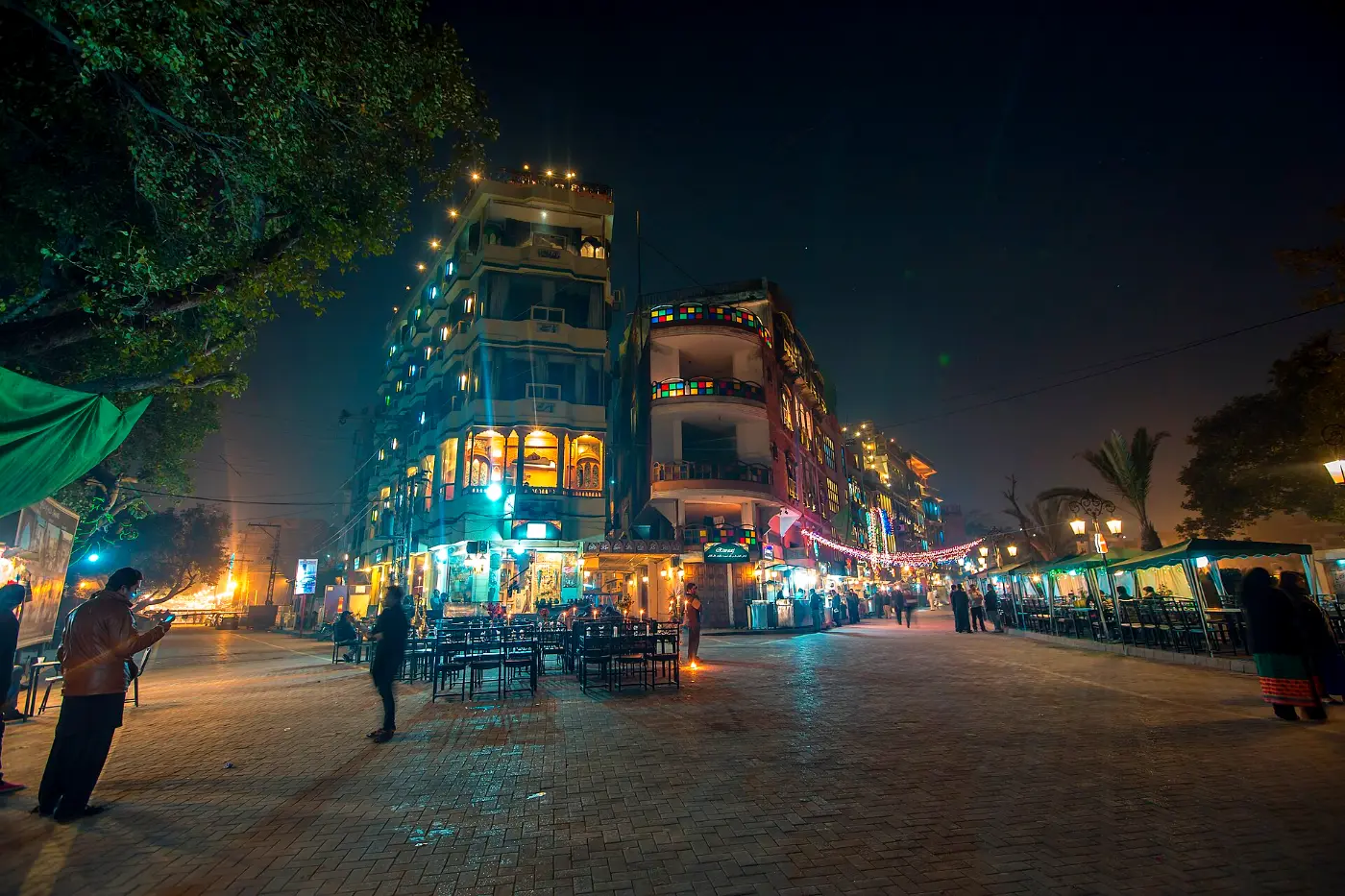
Fort Road Food Street at night. Photo Credit: Tahsin Shah, CC BY-SA 4.0.
Visitor Information
- Location: Inside Masti Gate, Walled City of Lahore, opposite the Akbari Gate of the Lahore Fort.
- Timings: The mosque is open daily for the five prayers. Visit between prayers, and avoid Friday afternoon.
- Entry fee: Free. A small donation is welcome.
- Best time: October to March, in the morning after 9 am.
- Time needed: 30 to 45 minutes.
- Parking: There is no parking at the mosque. Park near Minar-e-Pakistan or Fort Road and take a rickshaw.
- Dress code: Cover your arms and legs. Women should cover their heads, and everyone removes shoes before the prayer hall.
- Women and families: Families are welcome. However, women should check with the caretaker first, since there is no separate women’s section.
- Photography: Allowed, but do not photograph people while they pray.
- Accessibility: Steps lead down into the courtyard, and the lanes outside are uneven, so it is hard for wheelchair users.
- Safety: The Rim Market lanes are busy with traffic. Keep your phone and wallet safe.
Visiting Maryam Zamani Mosque Lahore Today
Since 2020, conservation work has gone on here in phases, led by the Walled City of Lahore Authority. Parts of the mosque may be closed at times, so check before you go.
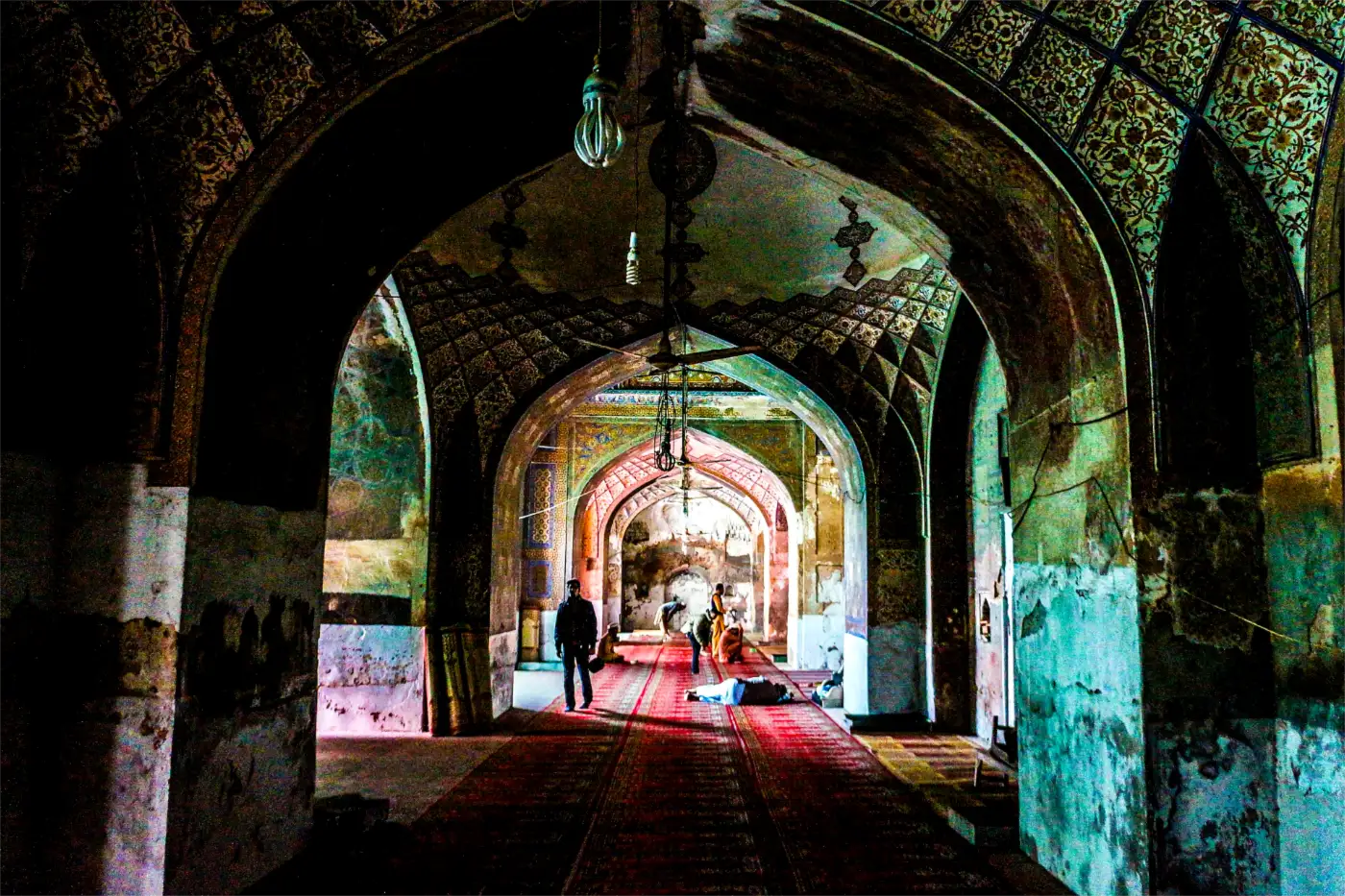
Inside the prayer hall. Photo Credit: Asif Nawaz, CC BY-SA 3.0.
How to Get There
Maryam Zamani Mosque stands just inside Masti Gate, on the north-east side of the Lahore Fort. By car, Careem or inDrive, ask for Masti Gate or Rim Market, then walk the last few minutes.
By public transport, take the Metro Bus to Azadi Chowk, near Minar-e-Pakistan. From there, a rickshaw along Circular Road to Masti Gate takes about ten minutes. Alternatively, walk the Royal Trail from Delhi Gate.
Places to Visit Near Maryam Zamani Mosque
- Lahore Fort: the Akbari Gate stands right opposite the mosque, although visitors enter the fort from the Alamgiri Gate.
- Hazuri Bagh and Badshahi Masjid: a short rickshaw ride around the fort.
- Sunehri Masjid: the golden mosque in Kashmiri Bazaar, on the Royal Trail.
- Wazir Khan Mosque and Shahi Hammam: further along the trail towards Delhi Gate.
- Rang Mahal: a busy old bazaar area on the way.
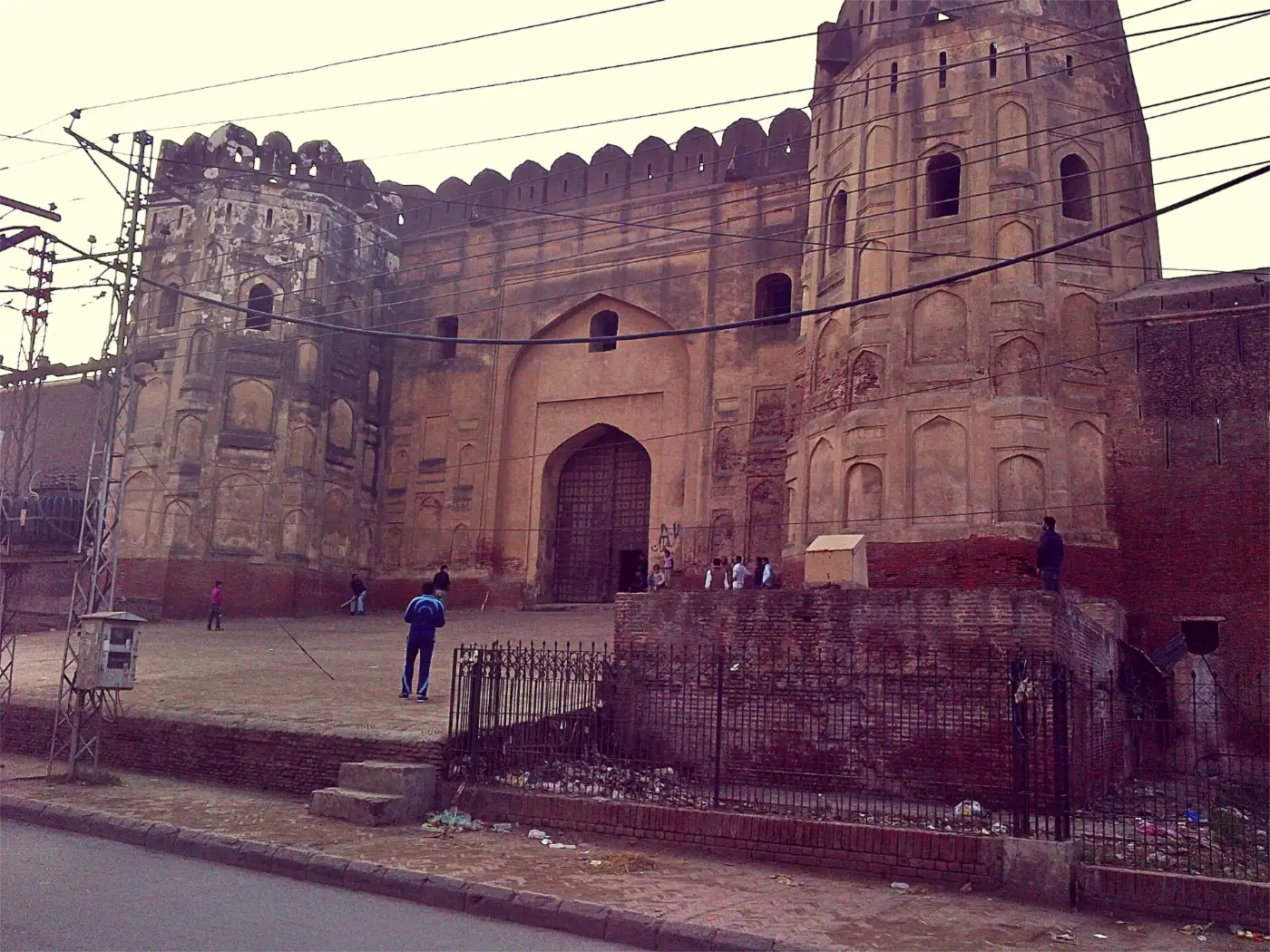
Akbari Gate of the Lahore Fort. Photo Credit: Muhammad Imran Saeed, CC BY 2.0.
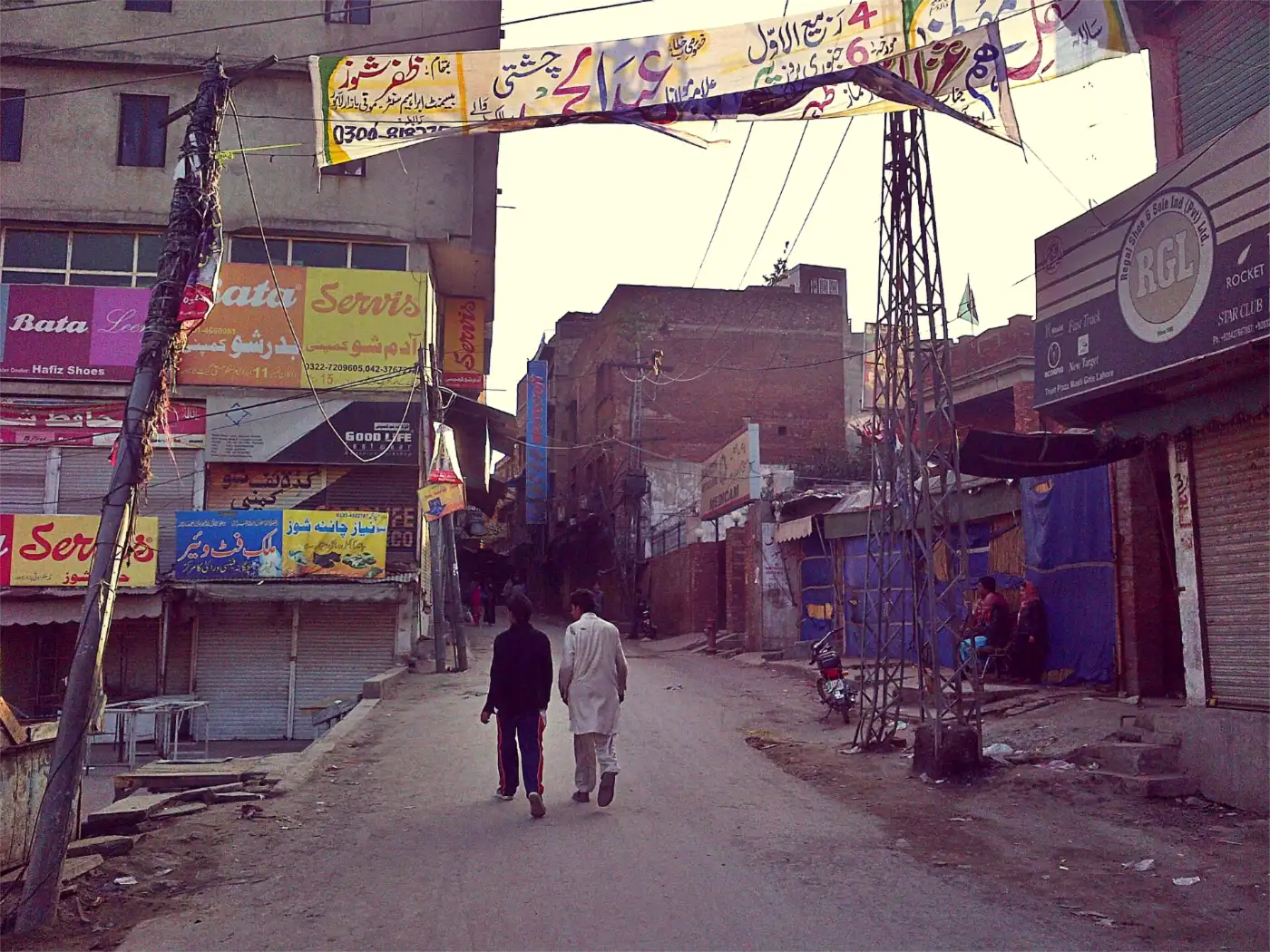
Masti Gate. Photo Credit: Muhammad Imran Saeed, CC BY 2.0.
Frequently Asked Questions
Is Maryam Zamani Mosque the oldest mosque in Lahore?
Yes, it is the oldest dated Mughal-era mosque in Lahore. Builders finished it in 1614, about 20 years before Wazir Khan Mosque.
Who built Begum Shahi Masjid?
Mariam-uz-Zamani, the wife of Emperor Akbar and mother of Emperor Jahangir, built it during Jahangir’s reign.
Is there an entry fee?
No. Entry is free, since it is a working mosque.
Can tourists visit outside prayer times?
Yes. In fact, the best time to visit is between prayers, when the hall is quiet.
How far is it from Wazir Khan Mosque?
It is roughly a 20-minute walk along the Royal Trail through Kashmiri Bazaar.
Conclusion
Maryam Zamani Mosque is small, crowded in by shops and easy to miss. Still, it holds some of the finest Mughal frescoes in the subcontinent, and it set the plan for the great mosques that came after it. So next time you walk the Royal Trail, do not stop at Wazir Khan. Keep going to Masti Gate, take off your shoes, and look up.
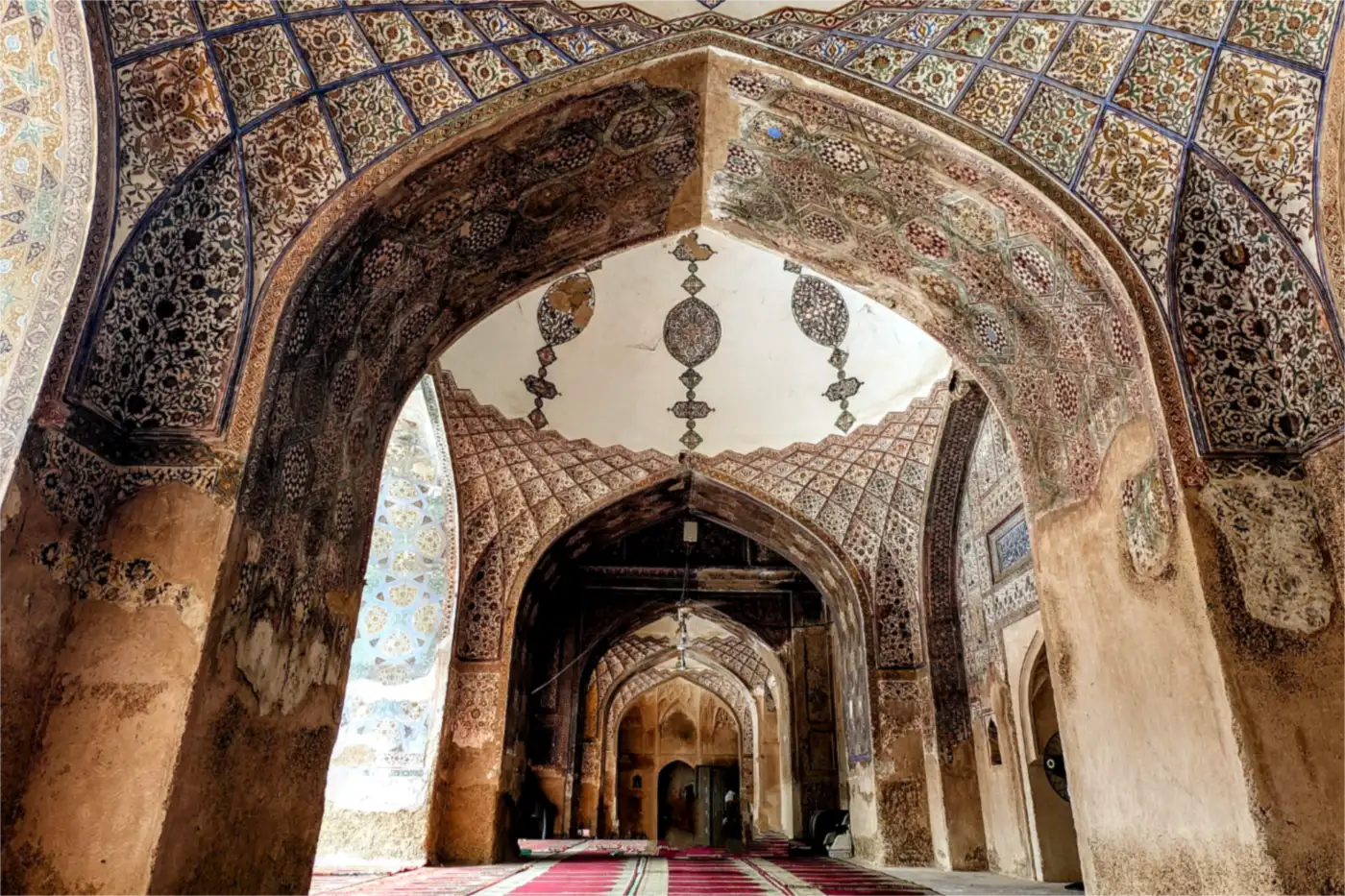
Arches of the prayer chamber. Photo Credit: Muhammad Umair Mirza, CC BY-SA 4.0.
Cover photo: Muhammad Umair Mirza, CC BY-SA 4.0 (edited).